
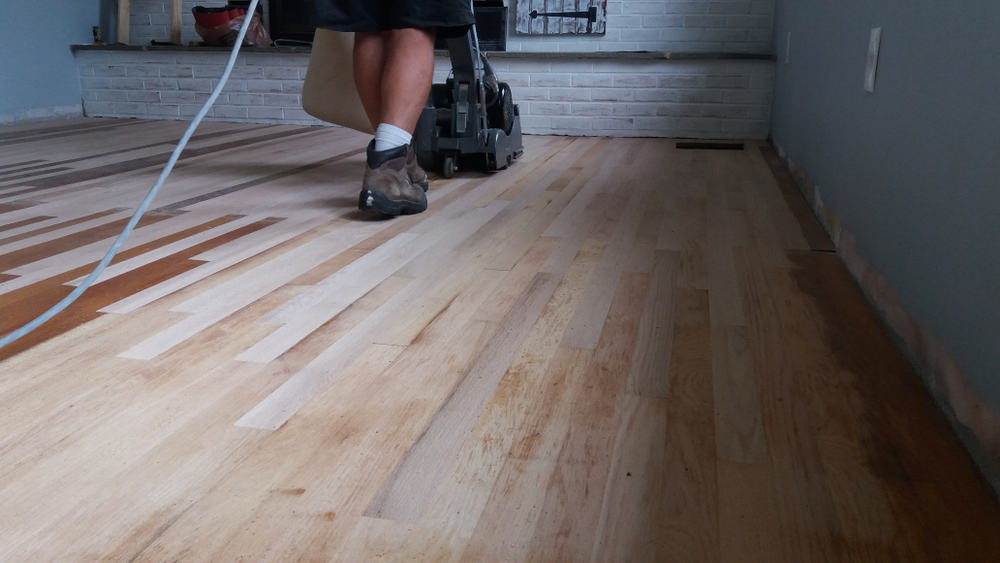
You probably noticed it sometime in July or August — a board that feels slightly raised, a stretch of floor that looks duller than it used to, or scratches that weren’t there in May. Nassau County summers do real work on hardwood floors, and by mid-August, most homes on Long Island are showing at least some of it. The good news is that most summer damage is repairable. The less good news is that waiting too long — or misreading what you’re dealing with — can turn a straightforward fix into a much bigger one. Here’s how to read what your floors are telling you right now.
Why Nassau County Summers Are So Hard on Hardwood Floors
Long Island averages 70 to 75 percent relative humidity in July and August. The National Wood Flooring Association recommends keeping indoor humidity between 35 and 55 percent to prevent damage. That means Nassau County floors are routinely exposed to humidity levels that blow past the safe zone by 20 to 40 percentage points — every single summer, for months at a stretch.
Wood is porous. It absorbs moisture from the air, expands when humidity is high, and contracts when the air dries out in fall and winter. That seasonal cycle is normal. But when the humidity swings are as dramatic as they are here, the stress on your floors adds up year after year.
If you’re in a South Shore community — Long Beach, Oceanside, Freeport, Merrick, Wantagh — you’re dealing with sustained coastal humidity from the Atlantic that runs even higher than the county average from June through September. That extra moisture load is why we see more severe cupping and finish damage in waterfront Nassau County homes than inland.
What Cupped Hardwood Floors Actually Mean — and Whether They’ll Fix Themselves
Cupping is the most common form of summer humidity damage, and it’s also the most misunderstood. It happens when the bottom of a floorboard absorbs more moisture than the top, causing the edges to rise and the center to dip. Run your hand across the floor and it feels slightly washboard-like. Walk across it and you can feel the unevenness underfoot.
A lot of homeowners assume cupped floors will flatten out on their own once the humidity drops in September and October. Sometimes that’s true — for very mild cupping in a well-maintained floor, the boards may relax back to flat as the air dries out. But there are two problems with the wait-and-see approach.
First, you can’t reliably judge the severity of cupping without a professional assessment. What looks like mild surface cupping can involve a moisture imbalance coming from below — from a crawl space, a basement, or a subfloor that’s holding water — rather than just the ambient air. That kind of cupping won’t self-correct when fall arrives, because the moisture source isn’t going away.
Second, and this is the part that catches a lot of homeowners off guard: sanding a floor that still has elevated moisture content will make things worse, not better. If you sand while the wood is still expanded from humidity, the boards will contract as they dry — and instead of cupping, you’ll end up with crowning, where the center of each board humps upward. That’s a second repair on top of the first one. The right approach is to let the floor return to its normal moisture content first, confirm it’s stable, and then sand. Rushing that process is one of the most common and costly mistakes in hardwood floor repair.
About 75 percent of all hardwood floor problems trace back to moisture. On Long Island, that number probably skews even higher.
The Post-Summer Floor Inspection: What to Look for Room by Room
You don’t need to be a flooring professional to do a basic walkthrough of your home and flag what needs attention. You just need to know what you’re looking for and what it means.
Start with the rooms that took the most punishment this summer. In most Nassau County homes, that’s the kitchen, the main living area, and any room that runs on a window AC unit rather than central air. Window units cool the air but don’t dehumidify it nearly as effectively as a central system — which means rooms with window units often spent the summer sitting at 70-plus percent humidity even when they felt comfortable temperature-wise.
**Cupping** shows up as a slight waviness or raised edge along the length of the boards. Get low and look across the floor at an angle — you’ll see it more clearly in raking light. If it’s there, don’t sand it yet. Call for an assessment first.
**Surface scratches** are the other big summer complaint, and they’re almost always worse than homeowners expect by August. Kids home from school, dogs going in and out, furniture moved around for summer gatherings — the foot traffic in a Nassau County home in July is nothing like it is in February. Fine surface scratches that catch the light, deeper gouges from furniture legs, and scuff marks from shoes all fall under the category of hardwood floor scratch repair, and the fix depends entirely on how deep the damage goes. Scratches that haven’t broken through the finish layer can often be addressed with a screen-and-recoat — a lighter process than full sanding that restores the surface without removing significant wood. Deeper gouges that reach the wood itself need more involved spot repair or, in some cases, board replacement.
**Finish dullness** is easy to overlook because it creeps up gradually. If your floors looked great last fall and now look flat and lifeless, the finish has likely been stripped down by summer cleaning habits — too-wet mopping, the wrong floor cleaner, or products with oil or “shine” additives that actually degrade polyurethane over time. This is one of the most reversible forms of summer damage, but it won’t fix itself.
**Gapping** — small spaces opening between boards — is worth monitoring. Some seasonal gapping is completely normal and will close again as humidity drops in fall. Gaps that have been there all summer and show no sign of closing are worth having looked at.
Don’t skip your stairs. Stair treads take the same humidity abuse as your main floors and often show cupping, finish wear, and surface scratches that go unnoticed until someone points them out.
How to Fix Hardwood Floors After a Long Island Summer
The repair process for summer humidity damage isn’t one-size-fits-all. What your floors actually need depends on the type of damage, how severe it is, and — critically — whether the moisture levels in the wood have returned to normal before any sanding begins.
A professional assessment answers all of those questions at once. It tells you whether you’re dealing with ambient humidity damage or a moisture source that needs to be addressed first. It tells you whether a screen-and-recoat will handle the surface issues or whether full sanding and refinishing is the right call. And it tells you whether any boards need spot repair or replacement before the refinishing work starts.
Wood Floor Repair: What the Process Actually Looks Like
For most Nassau County homeowners dealing with post-summer damage, the repair process starts with a moisture assessment. Before anything gets sanded, the wood needs to be at or near its equilibrium moisture content — the point at which it’s stable and not still releasing or absorbing humidity. Most hardwood flooring is manufactured to a moisture content of 6 to 9 percent. After a Long Island summer, the wood in your floors may be sitting well above that. Sanding before it returns to range is the single most common way a repair job goes wrong.
Once moisture levels are confirmed stable, the scope of the work becomes clear. Minor surface damage — light scratches, dull finish, superficial scuffs — can often be addressed with a screen-and-recoat, which scuffs the existing finish lightly and applies a fresh coat on top. It’s faster, less disruptive, and preserves more of your floor’s thickness than a full sand. For Nassau County homes with original 1950s or 1960s oak floors that have already been refinished a few times, preserving that thickness matters — there’s a limit to how many times a floor can be sanded before you’re getting too close to the tongue-and-groove.
More significant damage — moderate to severe cupping, deep scratches, boards that have lifted or buckled — requires full sanding down to bare wood, followed by staining (if desired) and two to three coats of finish. This is where color matching and finish sheen become important. A repair that doesn’t match the surrounding floor is its own kind of problem. Getting it right takes experience and an eye for color, not just technical skill.
Fall is genuinely the best time of year for this work on Long Island. Humidity drops, temperatures moderate, and you can open windows for ventilation while the finish cures. The catch is that the fall booking window fills up fast — homeowners who wait until October to call are often looking at a four-to-six-week wait. Getting an assessment done in August means you’re ahead of that rush.
Hardwood Floor Scratch Repair: When You Can DIY and When You Shouldn’t
This is one of the most common questions we hear after summer, and the honest answer is: it depends on the depth of the scratch.
Very fine surface scratches — the kind that show up in certain light but don’t catch your fingernail when you run it across the floor — haven’t broken through the finish. Those can sometimes be touched up with a color-matched hardwood floor marker or a small amount of finish applied with a cloth. It’s not a permanent fix, but it can buy time until a full screen-and-recoat makes sense.
Scratches that catch your fingernail have broken through the finish and reached the wood itself. Those need more than a touch-up. Left alone, they’ll absorb moisture and dirt, darken over time, and become more visible, not less. If you have a cluster of them in a high-traffic area — in front of the kitchen sink, at the base of the stairs, in the main hallway — spot repair followed by a screen-and-recoat is usually the right call. It addresses the damaged area without requiring a full sand of the entire floor.
Deep gouges from furniture legs, pet claws that have worn through to bare wood, or areas where something heavy was dragged across the floor are a different category. Those often require individual board repair or replacement, which means matching the species, width, and stain color of the existing floor. This is where experience genuinely matters — a patch that doesn’t blend is worse than leaving the gouge alone, because it draws the eye every time someone walks into the room.
Renting a floor sander and tackling this yourself is a high-risk move. The machines are the same ones professionals use, but operating them without experience on older Long Island floors — floors that may only have one or two refinishing passes left in them — can cause irreparable damage in minutes. The cost of fixing a DIY sanding mistake is almost always higher than the cost of having a professional do it right the first time.
If you’re not sure whether what you’re looking at is surface damage or something deeper, a free estimate is the easiest way to find out.
When to Schedule Hardwood Floor Repair on Long Island
If you’ve walked through your Nassau County home and found any combination of wavy boards, scratched surfaces, dull finish, or widening gaps, mid-August is exactly the right time to act. Not because the damage is necessarily urgent today, but because the fall window — the best season for refinishing on Long Island — books up fast, and homeowners who wait until the damage becomes impossible to ignore are often waiting weeks longer than they need to.
Most summer floor damage is very repairable. But the difference between a straightforward fix and a costly one usually comes down to how long you wait and whether the repair is done in the right sequence. Getting a professional set of eyes on your floors now costs nothing and tells you exactly where you stand.
We’ve been working on Long Island hardwood floors for over 50 years. If you’re ready to find out what your floors actually need, reach out for a free, no-obligation estimate — and get ahead of the fall rush before the schedule fills.