
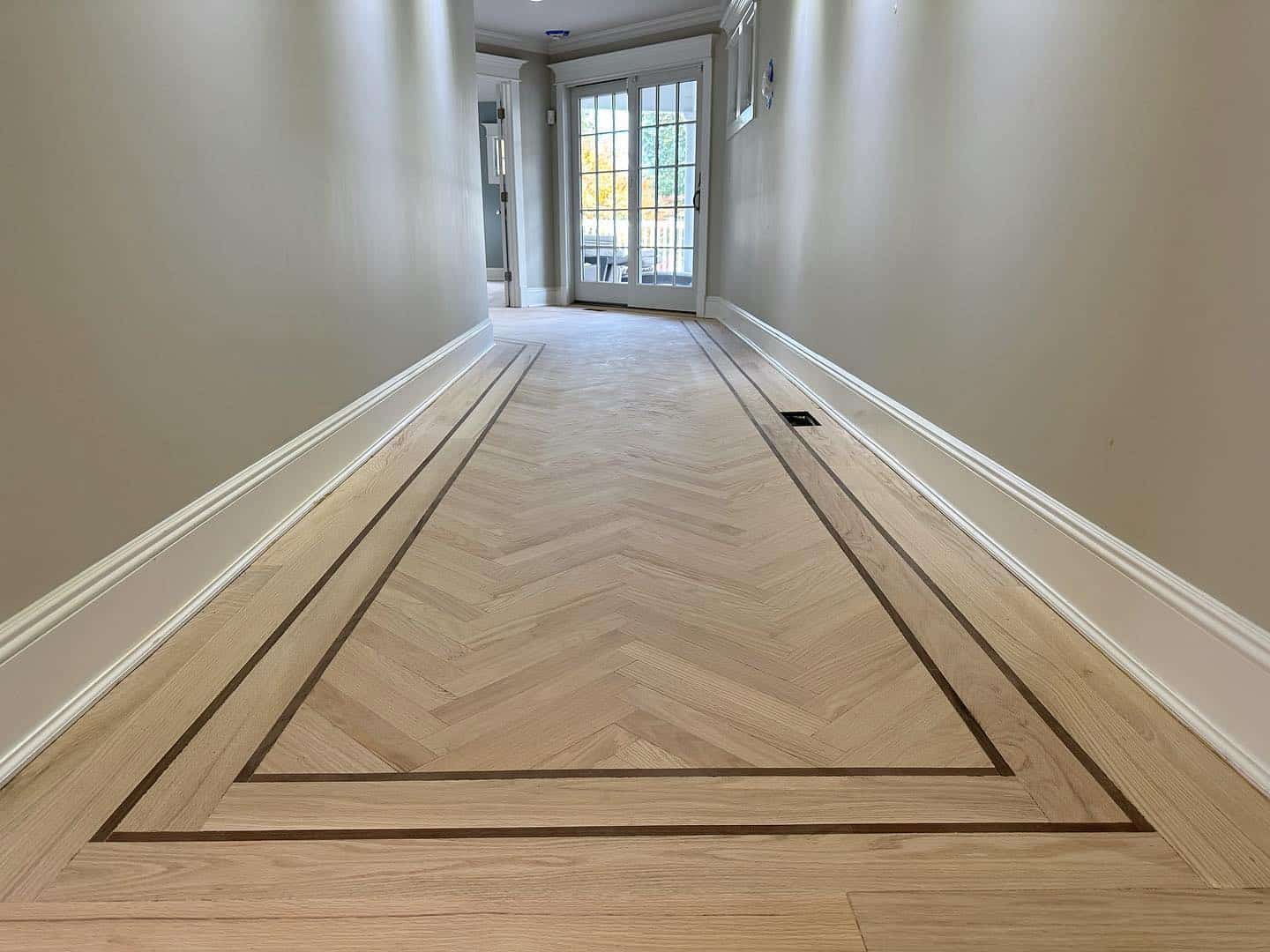
You’ve seen the zigzag floor on a Pinterest board, in a showroom, or maybe under the carpet of the house you just bought on Long Island. Everyone calls it chevron. Often it isn’t, and that small mix-up matters more than it sounds. What you have decides what a repair costs, how we approach it and whether sanding is safe. If you’re weighing new chevron hardwood floors against saving a patterned floor you already own, this will help you sort it out. First, let’s work out which pattern is actually in front of you.
Chevron vs. Herringbone: How To Tell Which Floor You Have
Look at where two boards meet. On chevron hardwood floors, the ends are cut at an angle (usually 45 degrees and sometimes 60) so the boards join in one clean, continuous V. Herringbone uses square-ended boards set in a staggered zigzag, so you see small steps instead of a seamless point.
Why does it matter? All that angled cutting creates more waste, so chevron costs more to produce. It’s also one of the harder floors to fit well. When it’s time to repair or refinish, knowing which one you have tells us where the joints and V points need the most care. Snap a close-up photo of a few boards and you can settle this in a minute.
Can You Refinish Herringbone Or Chevron Hardwood Floors?
Yes, in most cases. Patterned floors can be refinished, and plenty of Long Island homeowners are surprised to hear it. The fear is fair, though. Sanding a floor where the boards point in different directions is not the same as sanding straight plank. A machine that’s wrong for the job can chatter and gouge across the joints, which is why we steer people away from renting a sander for this kind of floor.
What it really comes down to is how much wood you have left. The National Wood Flooring Association describes refinishing as sanding a finished floor to bare wood and applying new stain or finish, so there has to be enough thickness to take it. Solid boards usually do. Engineered boards depend on the wear layer, so have someone check before you assume either way.
This question comes up all the time in older Long Island homes, where original oak has been sitting under carpet for decades. Once the carpet comes out, a sanded and refinished floor can look like a different room. Color is part of that. In Lloyd Harbor, we sanded, sealed and finished traditional red oak to give it a lighter, more Hamptons feel. Same boards, new look.
Nationally, refinishing runs about $3 to $8 per square foot, a fraction of what new patterned flooring costs. Patterned floors and Long Island labor can sit above those averages, so treat them as a starting point.
Should You Restore An Old Patterned Floor Or Replace It?
Sometimes a floor needs more than a sanding, and you should hear that up front. Water damage, loose or missing boards and old patches that don’t match the pattern all need attention before any finish goes on. Replacing boards inside a pattern takes patience, because every piece has to match the angle and line up with its neighbors.
The subfloor is the other big factor. A pattern shows every high and low spot, and misaligned V points are hard to hide. One homeowner had a floor that was part original hardwood and part plywood. We recommended pulling it up, leveling the subfloor and laying new oak so it ran with the flow of the rooms. Patching would never have given them that result.
Restore when the boards are sound and the layout makes sense. Replace when the base underneath is the problem, or when the pattern has been chopped up past reasonable repair. We can tell you which one you’re dealing with once we see the floor in person. Sometimes it’s a mix: refinish the main rooms, then bring the stairs and handrails in line so everything matches.
We also hear from people who tried installing floors from a home store and ended up with something that didn’t work. If that’s you, call us and we’ll take a look. You’re not the first, and a failed first attempt doesn’t always mean starting from zero.
Installing New Chevron Hardwood Floors On Long Island
If you’re starting fresh, whether it’s a Nassau County renovation or a Suffolk County remodel, chevron is a layout-first job. We set a straight reference line, often with a laser, and let it cure fully before laying the rest. Small errors multiply as the rows travel across a room. Rush it and the pattern can drift, a problem manufacturers call creep, with gaps opening at the edges.
Prep matters just as much. The subfloor needs to be flat and dry, and the wood needs time to acclimate. Long Island’s humid summers and dry heating season keep wood moving, so we always run moisture testing before install. White oak, red oak and hickory are common species, in solid 3/4 inch or engineered.
How Much Do Chevron Hardwood Floors Cost On Long Island?
Chevron costs more than herringbone, and the labor line is where the money goes. On Long Island, we put herringbone and chevron labor at $10 to $20 per square foot, because the precision cutting takes time. Labor for standard installs averages $3 to $8 per square foot nationally, and Nassau sits at the high end of that or above.
To make it concrete, the typical Nassau single-family home runs around 1,887 square feet. For a home that size, a realistic installed cost lands between $18,870 and $37,740. Your number moves with species, subfloor prep and how much of the house you’re doing. A foyer or dining room is a very different calculation than the whole first floor.
Refinishing looks different next to that. National benchmarks run $3 to $8 per square foot, and This Old House puts the average project around $1,800. Patterned floors and Long Island labor can land above those averages, so use them to compare options, not as a quote.
If you’ve collected three or four estimates and they’re all over the place, the gaps usually come from what’s included. Subfloor leveling, furniture moving, species and finish all change the number. Ask each contractor to break out labor and materials. A quote that tells the whole story up front is easier to compare, and it’s how we write ours.
What Should Be In Writing Before Anyone Installs Or Sands Your Floor?
Most horror stories about patterned floors start with a vague contract. Species mix-ups, schedules that stretch far past the promise and finishes that don’t match the sample are the worries we hear most. Nearly all of them can be headed off with a written scope before work starts.
Get the species, grade, plank width and pattern angle spelled out, so there’s no confusion between a 45-degree and a 60-degree chevron. Add the finish, who moves the furniture and a start and end date. Ask to approve a sample board before the install begins. It takes ten minutes and saves a lot of arguing later.
Then check the contractor. Nassau County requires home improvement contractors to hold a license from its Department of Consumer Affairs, so ask to see it, along with proof of insurance. Ask for photos of past local work, and read reviews for patterns, not just the star count. One glowing review means little. Ten that mention the same things (fast replies, straight answers and a floor that held up) mean a lot.
Find out who you’ll actually deal with. We’re a family-run company out of Huntington Station, and you’ll know who to call when you have a question halfway through the job. On a floor you’ll walk on for decades, that matters more than most of what’s on a brochure.
Ready To Install, Refinish Or Restore Your Chevron Hardwood Floors On Long Island?
Start with the V. If the boards meet in a continuous point, you have chevron, and if they step in a zigzag, it’s herringbone. From there, the choice is simpler than it looks. Sound boards usually mean refinishing, damage or a bad subfloor may mean restoring or replacing, and a blank room means a layout-first install with the scope in writing.
Whether you’re in Nassau, Suffolk or Queens, the next step is the same: let us look at the floor in person. We’ll walk through what you have, what it needs and what it should cost, with a free estimate and no pressure. Reach out to KO Floors, Inc. and bring your photos, your questions and any quotes you’ve already collected.