
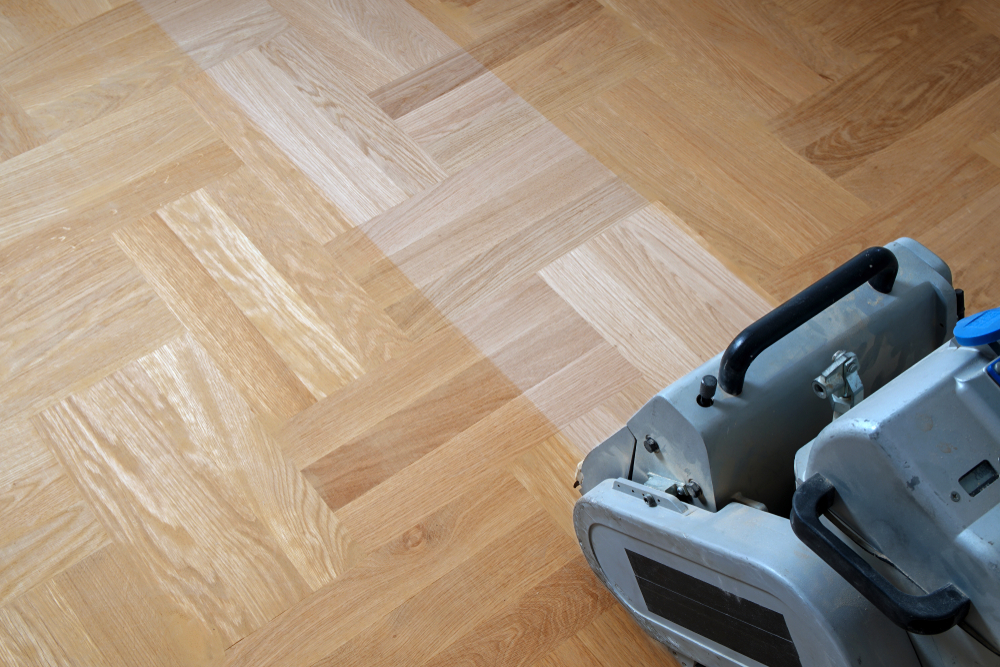
Pull back the corner of an old carpet in a Nassau County home built in the 1950s and there’s a good chance you’ll find hardwood underneath. Solid oak, often original, often refinishable — and usually looking far worse than it actually is.
That’s the thing about hardwood floors. They can take a lot of abuse and still come back. Scratches, dullness, old stain that’s gone out of style — most of it sands away. What’s left is a floor that can look completely new without the cost or disruption of a full replacement.
Here’s what you need to know before you make any decisions.
Hardwood Floor Sanding: The Foundation of Any Real Refinishing Job
Refinishing starts with sanding — and sanding done right is what separates a floor that looks great for years from one that starts showing problems within months. The process removes the old finish, evens out the surface, and opens the wood up to accept new stain and finish cleanly.
It’s not a single pass. A proper sanding sequence moves through progressively finer grits, starting coarse enough to cut through the old finish and ending fine enough to leave a smooth, scratch-free surface. The center of the floor gets the drum or orbital sander. The edges, corners, and areas near the toe-kicks get hand tools. Both matter equally — and cutting corners on either one shows up clearly once the finish goes down.
Sanding and Refinishing Hardwood Floors: What the Full Process Actually Looks Like
The full process has more steps than most homeowners expect, and that’s not a bad thing — it’s what makes the result last.
Before any sanding begins, we inspect the floor thoroughly. We check the board thickness to determine how many times the floor has already been sanded, look for damaged boards that need repair or replacement, and assess moisture levels. Nassau County’s coastal climate — with humid summers and dry winters — causes wood to expand and contract seasonally, and a floor that’s been exposed to moisture needs to be properly dried before refinishing begins. Skipping this step leads to finish failures down the line.
Once the floor is ready, sanding proceeds in stages. Coarse grits remove the old finish and level out surface imperfections. Medium grits smooth out the scratch pattern left by the coarse pass. Fine grits prepare the surface for stain or finish. Each pass matters. Jumping grits to save time leaves visible scratches that show through the final finish — especially under raking light near windows.
After sanding, any cracks or gaps in the boards get filled. Then staining, if you want a color change. Then the finish goes down in multiple coats — typically two to three — with light sanding between coats for adhesion. Oil-based polyurethane takes longer to dry and has a slight amber tone. Water-based dries faster and stays clearer. Both are durable when applied correctly.
One part of the process worth mentioning: stain color selection. The same stain looks different on different wood species and in different lighting conditions. We apply sample colors directly to your actual floor — not just hand you a chip card — so you can see exactly what you’re committing to before the job starts. This is one of those details that sounds small until you’re living with a color you didn’t expect.
Hardwood Floor Inspection: How to Know If Your Floors Can Be Refinished
This is the question most Nassau County homeowners ask first, especially when they’ve just pulled up old carpet and found wood that looks rough. The honest answer is that most solid hardwood floors can be refinished — even ones that look bad.
The key variable is board thickness. Every time a floor gets sanded, a thin layer of wood is removed permanently. Most solid hardwood floors can be sanded three to five times over their lifetime. If a floor has already been refinished multiple times, the boards may be too thin to sand again safely. We can measure the wear layer and tell you where you stand.
Structural damage is a different conversation. Boards that are cracked, rotted, or severely warped may need to be replaced individually before refinishing can proceed. But surface-level damage — scratches, stains, dullness, worn finish, even minor cupping — is usually addressable through refinishing.
For Nassau County homes built in the 1950s and 1960s, the original hardwood is often solid oak or maple, typically 3/4 inch thick. Even after decades under carpet, these floors frequently have plenty of wear layer left. The carpet that covered them may have actually protected them. It’s worth having someone take a look before you assume replacement is the only option.
One more thing: engineered hardwood is a different situation. Whether it can be refinished depends on the thickness of the top veneer — the real wood layer on top of the plywood core. Thicker wear layers can handle light sanding. Thinner ones may only be candidates for a buff-and-coat, which refreshes the surface without removing wood. A proper inspection will tell you which category your floor falls into.
Dustless Wood Floor Refinishing: Why It Changes the Conversation
The single biggest reason Nassau County homeowners put off refinishing is dust. Traditional floor sanding generates enormous amounts of fine wood dust that settles on every surface in the house, gets pulled into HVAC systems, and takes days to fully clean up. It’s a real concern, especially in older homes where ductwork is harder to seal off.
Dustless refinishing addresses this directly. Modern dustless sanding systems connect commercial-grade vacuums directly to the sanding equipment, capturing the dust at the source before it has a chance to spread. The result is a dramatically cleaner process — these systems capture roughly 95 to 98 percent of sanding dust during the job. It’s not completely dust-free, but the difference compared to traditional sanding is significant.
Dustless Hardwood Refinishing vs. Traditional Sanding: What’s Actually Different
The refinishing process itself is the same either way — the same sanding sequence, the same finish application, the same cure time. What changes is how the dust is managed during the sanding phase.
With traditional sanding, the dust generated by the drum sander and edger disperses freely into the room and throughout the house. We typically tape off vents and cover doorways to limit spread, but fine particles still find their way into adjacent spaces. In a home with a forced-air HVAC system, that dust can circulate for days.
Dustless systems attach high-capacity vacuums directly to the sanding equipment. The suction captures the majority of dust as it’s created, before it becomes airborne. The work area still needs to be prepped — vents covered, electrical boxes taped — but the volume of dust that escapes into the rest of the home is dramatically reduced.
For Nassau County homeowners, this matters for a few specific reasons. Many of the county’s older homes have HVAC systems that are harder to fully seal off during a renovation. Families with allergies, young children, or pets have additional reasons to care about air quality during the job. And anyone who’s already cleared furniture out of multiple rooms doesn’t want to spend a week cleaning fine dust off every surface afterward.
Dustless refinishing does tend to cost more than traditional sanding — the equipment is a meaningful investment, and not every contractor has it. But for most homeowners, the tradeoff is straightforward: a cleaner process, less disruption, and a home that’s livable again much faster.
Refinishing Engineered Wood Floors Without Sanding: When a Buff-and-Coat Makes More Sense
Not every floor needs to be sanded down to bare wood. For engineered hardwood with a thin wear layer, or for solid hardwood that’s been sanded multiple times and is getting close to its limit, a buff-and-coat is often the right call.
The process works differently than full refinishing. Instead of sanding to bare wood, the existing finish is lightly abraded — scuffed up just enough for the new finish coat to bond to it. A fresh coat of polyurethane goes on top. The result is a refreshed, more protective surface, but without the color change or scratch removal that comes from sanding all the way down.
Buff-and-coat is faster, less disruptive, and less expensive than full refinishing. It’s also more limited. It won’t remove deep scratches, it won’t let you change the stain color, and it won’t address cupping or boards that have shifted. Think of it as a maintenance step — something you might do between full refinishing cycles to extend the life of the finish.
For Nassau County homeowners with engineered hardwood installed in the last 10 to 15 years, this is often the relevant question. Many engineered floors installed during that period have wear layers in the 2mm to 4mm range — enough for one or two light sandings, but not the kind of aggressive refinishing you’d do on a 3/4-inch solid oak floor. A contractor who inspects the floor properly will tell you which method is appropriate rather than defaulting to the more expensive option.
The broader point is that refinishing isn’t one-size-fits-all. The right approach depends on what kind of floor you have, what condition it’s in, and what outcome you’re trying to achieve. That’s exactly why a proper inspection before any work starts isn’t optional — it’s the whole foundation of getting the job right.
Hardwood Floor Refinishing in Nassau County: What to Do Next
Most Nassau County homeowners who look into refinishing find out their floors are in better shape than they thought. The wood that’s been sitting under carpet in a 1950s Lynbrook colonial or a Rockville Centre split-level is often solid, refinishable, and capable of looking genuinely new with the right process behind it.
The decision usually comes down to three things: knowing whether your floors are actually candidates for refinishing, understanding what the process involves so there are no surprises, and finding a contractor who will do the job correctly the first time.
If you’re at the point where you want someone to take a look and give you a straight answer, we’re happy to help. We’ve been working with Nassau County homeowners for over 50 years, and we offer free, no-obligation quotes — no pressure, no guesswork, just an honest assessment of what your floors need and what it will take to get them there.