
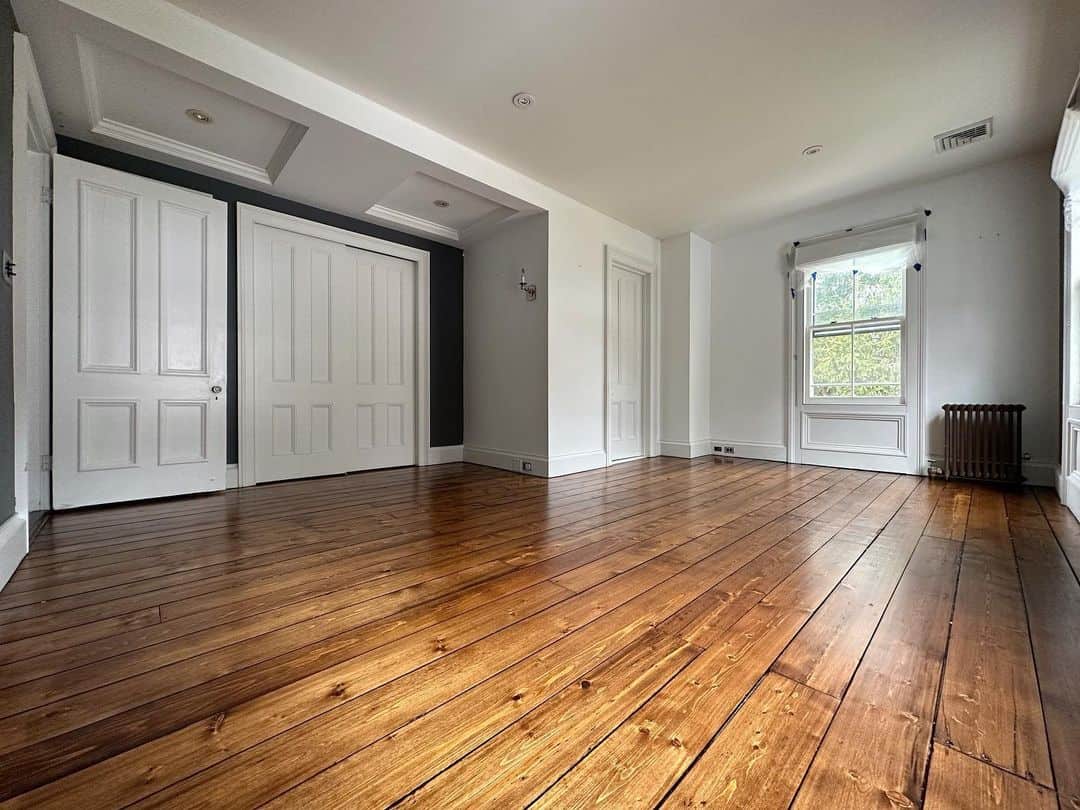
If you’re searching for hardwood floor replacement cost, you’re probably not looking for a lecture on the beauty of wood grain. You want a real number — or at least a realistic range — before you pick up the phone and start talking to contractors. That’s fair. Most cost guides give you a national average that doesn’t account for where you actually live, what’s actually under your floors, or what surprises tend to show up once the work begins. This guide is written specifically for Nassau County homeowners. The numbers are grounded in what projects here actually look like — not what they look like in Phoenix or Omaha.
Flooring Cost Per Square Foot: What Nassau County Homeowners Are Actually Paying
Nationally, hardwood floor replacement runs somewhere between $6 and $25 per square foot installed — materials and labor combined. On Long Island, most mid-range projects land between $10 and $16 per square foot, though premium species like walnut or wide-plank white oak can push that number higher. Labor rates in Nassau County run above the national average, which is just the reality of working in this market.
For a typical Nassau County home — say, a 1,200 square foot ranch in Levittown or a split-level in Massapequa — that translates to a total project cost somewhere in the range of $12,000 to $19,000 before any surprises. Smaller projects cost less per square foot in materials but don’t always scale down proportionally on labor. Contractors have a floor on what it costs to mobilize, prep, and finish a job properly.
Cost of New Floors: What’s Actually Driving the Price Up or Down
The floor cost per square foot you see in any estimate is really the sum of several moving parts — and understanding those parts is what separates a homeowner who gets a fair deal from one who gets surprised by the final invoice.
Wood species is one of the biggest levers. Standard domestic red oak is the most affordable option and still the most common species in Nassau County homes. White oak, hickory, and maple cost more. Exotic species like Brazilian cherry or walnut can push material costs significantly higher, and that’s before installation begins.
Plank width matters too. Narrow strip flooring (the classic 2¼-inch oak you’ll find in most post-war Nassau County homes) is generally less expensive to install than wide-plank boards, which require more precision and care to keep flat and stable over time.
Then there’s the subfloor. This is where a lot of Nassau County projects get more expensive than the initial estimate suggested — not because a contractor is padding the bill, but because older homes genuinely have older subfloors. The average single-family home in Nassau County is 73 years old. That means many of these homes were built in the late 1940s and 1950s, during the post-war suburban boom that gave us Levittown and hundreds of similar neighborhoods across the county. Subfloors from that era can have moisture damage, soft spots, uneven sections, or layers of old flooring material that need to come out before anything new goes down. Subfloor repairs typically add $1 to $3 per square foot to a project — sometimes more if the damage is significant.
Old floor removal is another line item that often catches homeowners off guard. Pulling up carpet is relatively straightforward. Removing glued-down vinyl or multiple layers of old flooring takes more time and labor, and in homes built before 1980, there’s a real possibility of asbestos-containing floor tile underneath. If that’s discovered, licensed abatement is required before the hardwood floor installation can proceed — a cost that no general flooring estimate will include because it depends entirely on what’s found.
Finally, staircases. If your project includes refinishing or replacing stair treads, that work is priced separately and can run up to $300 per step in the New York market. It’s detailed, time-consuming work, and it’s worth knowing that upfront rather than finding out when the estimate arrives.
Should You Replace or Refinish? The Decision Nassau County Homeowners Keep Getting Wrong
A significant number of homeowners searching for hardwood floor replacement cost are actually trying to answer a different question: do I need to replace at all, or can I just refinish? It’s worth spending a moment here, because the cost difference is not small.
Refinishing — sanding down the existing floor, applying new stain, and recoating — typically runs $3 to $8 per square foot. Full replacement runs $8 to $15 or more. In most scenarios, replacement costs three to five times more than refinishing. If your floors can be refinished, that’s almost always the more cost-effective path.
The catch is that not every floor can be refinished. Solid hardwood floors can typically be sanded and refinished multiple times over their lifespan — but each sanding removes a thin layer of wood, and eventually there’s not enough material left to sand again. If your floors have already been refinished several times, or if the boards are cupping, cracking, or showing structural damage, refinishing won’t fix the underlying problem.
Here’s where Nassau County’s housing stock creates a specific situation worth understanding. Many homes in communities like Westbury, Uniondale, East Meadow, and Rockville Centre still have their original hardwood floors from the 1940s and 1950s — often buried under carpet installed decades later. When that carpet comes up, homeowners sometimes discover floors in surprisingly good condition that can be fully restored. Other times, they find moisture damage, staining, or wood that’s simply too far gone. The only way to know which situation you’re in is an in-person assessment. No one can tell you over the phone.
Coastal proximity adds another layer of complexity for south shore Nassau County homeowners. Communities like Long Beach, Island Park, Oceanside, and Freeport experience more humidity variation than inland areas — the Atlantic Ocean and Reynolds Channel create conditions where hardwood expands in summer and contracts in winter more aggressively than it would in a drier climate. Floors in these areas are more prone to cupping, gapping, and finish failure over time. When moisture damage is the root cause of a floor’s condition, refinishing may provide a temporary cosmetic fix while leaving the underlying problem unaddressed.
Flooring Installation Cost Per Sq Ft: What Labor Actually Covers
Labor typically accounts for 50 to 70 percent of a hardwood floor installation project’s total cost. On Long Island, labor rates run between $3 and $8 per square foot depending on the complexity of the work — straightforward nail-down installation on a prepared subfloor sits toward the lower end, while glue-down installation, complex room layouts, or significant subfloor prep work pushes that number higher.
What you’re paying for in labor isn’t just the physical act of laying boards. It’s moisture testing, subfloor assessment, proper acclimation of the wood to your home’s specific humidity conditions, precision cuts around doorways and transitions, and the finishing work — multiple coats applied with proper cure time between each one. Shortcuts at any of these stages show up later as cupping, gapping, or finish failure.
Why the Quote You Get Over the Phone Is Almost Always Wrong
Phone quotes are a persistent problem in the flooring industry, and Nassau County homeowners are not immune to them. A contractor who quotes you a price without seeing your home is either padding the number to cover unknowns or leaving out the line items that will surface once work begins. Neither outcome is good for you.
The variables that drive hardwood floor replacement cost cannot be assessed remotely. Subfloor condition, existing moisture levels, the number of layers of old flooring that need to come out, the complexity of your room layout, the condition of your transitions and thresholds — all of these require eyes on the actual space. A number given over the phone is a guess at best and a lowball hook at worst.
This is especially true in Nassau County’s older housing stock. A home in Garden City or Manhasset built in the 1940s is a fundamentally different project than a newer build. The subfloor may be diagonal board sheathing rather than plywood. There may be multiple layers of flooring material accumulated over 70 years of renovations. The moisture profile of the home may have been shaped by decades of seasonal humidity swings, basement flooding history, or proximity to the water. None of that shows up in a square footage number.
An honest contractor will want to see the space before quoting anything. That visit — when done properly — is also when you get real answers about whether your floors can be refinished or need to be replaced, what the subfloor situation looks like, and what the project will realistically involve. It’s not a sales call. It’s the step that makes the actual quote meaningful.
We offer free, no-obligation in-home quotes because we think that’s the only way to give you a number you can actually rely on. Our team at KO Floors, Inc. has been doing this work on Long Island for over 50 years combined — we’ve seen the full range of what Nassau County homes look like under the carpet, and we’d rather tell you the truth upfront than surprise you with a revised invoice halfway through the job.
Does Replacing Hardwood Floors Increase Home Value in Nassau County?
This is one of the most common questions we hear from homeowners who are on the fence about the investment — and the data is genuinely encouraging, especially in a market like Nassau County.
According to the National Association of Realtors, new hardwood floor installation yields an average return of 118 percent at resale. Refinishing existing hardwood floors does even better — an average ROI of 147 percent, meaning homeowners who spend an average of $5,500 on refinishing recover approximately $8,000 at resale. Across multiple studies, buyers pay between $5,000 and $6,500 more for homes with hardwood floors, and 54 percent of buyers say they would pay a premium for a home that already has them.
In Nassau County, those numbers carry extra weight. The median home value here sits between $684,000 and $800,000 depending on the neighborhood. Buyers at that price point expect hardwood floors as a standard feature — not an upgrade. Homes in Great Neck, Manhasset, Oyster Bay, and similar north shore communities that go to market with worn, carpeted, or visibly dated floors are competing at a disadvantage against comparable listings that show well from the moment a buyer walks in.
For homeowners preparing to list, the calculus is fairly straightforward. A hardwood floor replacement or refinishing project is one of the few pre-sale renovations where the math consistently works in your favor. It’s visible, it’s expected by buyers in this market, and it photographs well — which matters enormously in a market where most buyers form their first impression from listing photos before they ever schedule a showing.
Even for homeowners who aren’t selling anytime soon, the NAR gave new wood flooring a Joy Score of 9.1 out of 10 in 2025 — among the highest of any home improvement project. That’s a reflection of how much people actually enjoy the result once it’s done, separate from any financial calculation.
The honest answer is that hardwood floors are one of the better investments you can make in a Nassau County home — but only if the work is done correctly. Floors that cup, gap, or show finish failure within a few years aren’t adding value to anything.
Getting a Realistic Hardwood Floor Replacement Cost in Nassau County
If there’s one thing to take away from all of this, it’s that hardwood floor replacement cost on Long Island isn’t a number you can pull from a national average and apply to your home. The age of your house, the condition of your subfloor, what’s currently under your carpet, your proximity to the water, and the specifics of your project all shape what you’ll actually pay.
The ranges are real — $6 to $25 per square foot installed, with most Nassau County mid-range projects landing between $10 and $16 — but the only way to know where your project falls is to have someone who knows Long Island homes look at yours.
KO Floors, Inc. has been doing exactly that for over 30 years. If you’re trying to figure out whether to replace or refinish, what your floors might look like under the carpet, or what a realistic budget for your home should be, reach out for a free, no-obligation quote. We’ll give you a straight answer.