
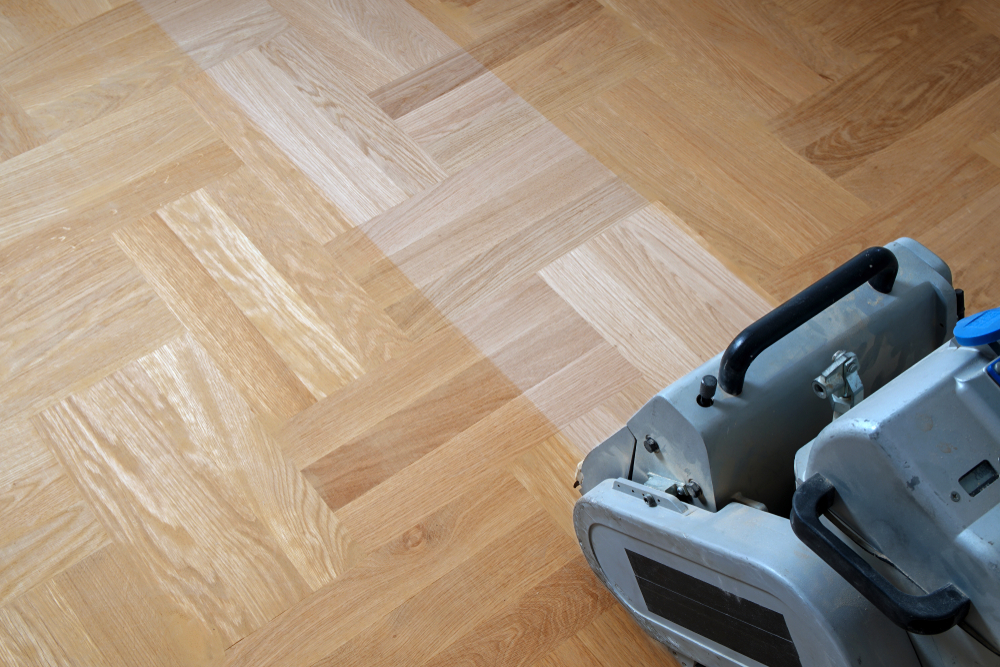
Here’s a fear we hear from Nassau County homeowners all the time: “I’m not going to call a flooring contractor because I already know what they’re going to say — that I need to replace everything.” That fear is understandable. And it stops a lot of people from finding out that their floors could actually be restored for a fraction of what replacement would cost.
The truth is, most original hardwood floors in Nassau County homes — the ones laid down in the 1950s, ’60s, and ’70s — are better candidates for restoration than homeowners realize. Here’s what you actually need to know.
Refinishing Old Hardwood Floors: What’s Actually Possible
Solid hardwood floors can typically be refinished up to ten times over their lifetime. Each professional sanding removes roughly 1/32 of an inch of the surface — which sounds like very little, but it adds up to a lot of runway when you’re starting with the 3/4-inch thick solid hardwood that was standard in Nassau County homes built during the post-war era.
The average single-family home in Nassau County is about 73 years old, which puts it squarely in the middle of the county’s explosive suburban expansion. Levittown was built between 1947 and 1951. The ranches and Cape Cods in Rockville Centre, Merrick, Wantagh, and Bellmore followed shortly after. All of those homes were built with solid hardwood floors as the standard — not a premium upgrade, just the way things were done. Many of those floors have only been refinished once or twice, if at all.
That means there’s a very good chance your floors still have several full restoration cycles left in them. The floor probably isn’t at the end of its life. It just looks that way.
How to Tell If Your Nassau County Hardwood Floors Can Still Be Refinished
The most important factor is how much wood remains above the tongue — the groove that locks each plank in place. If there’s less than 1/8 of an inch of wood above that point, or if you can see nail heads starting to surface through the floor, then the floor has been sanded down too far to go again safely. That’s the line. Short of it, you’re almost certainly in restorable territory.
For floors that have never been sanded or have only been done once, you’re nowhere near that threshold. A quick look at the edge of a floor vent or a threshold transition — anywhere the cross-section of the plank is visible — will give you a rough sense of how much material is left. If it looks thick, it probably is.
Water stains, pet damage, surface scratches, and dull or peeling finish are the things homeowners most often assume are death sentences for a floor. They’re usually not. Light water staining sands out completely in most cases. Deeper stains can sometimes be treated before finishing. Surface scratches disappear under the sanding process entirely. What you’re seeing on the surface of an old floor is almost never the whole story.
One detail that surprises a lot of homeowners: floors that have been covered by carpet for years are often in better condition than floors that have been exposed. Carpet protects hardwood from foot traffic, sunlight, and surface wear. When we pull back carpet in homes across Nassau County — in Massapequa, Hicksville, and Garden City — we regularly find floors underneath that need cleaning and refinishing rather than anything more involved. The floors were just waiting.
The cases where restoration genuinely isn’t the right call are real, but they’re less common than people assume. Structural rot from prolonged water damage, severe cupping that can’t be corrected through sanding, or boards that have been damaged beyond the point where they hold a finish — those are the situations where replacement makes sense. A thorough in-home assessment is the only way to know for certain, and we’ll tell you which category you’re in before you commit to anything.
Pine Floor Refinishing: What Nassau County Homeowners Need to Know
Older Nassau County homes — particularly those built before 1960 and many of the larger North Shore properties in Great Neck, Manhasset, and Port Washington — often have original pine floors, either as primary flooring on the main level or on upper floors. Pine floors get dismissed more than any other type, usually because a contractor without the right experience takes one look at the softness of the wood and recommends replacement.
That’s the wrong call in most cases. Pine floors can absolutely be refinished, but they require a different approach than oak. Pine is softer, which means it dents and scratches more easily — but it also means it responds well to the sanding process when done correctly. The risk isn’t in the refinishing itself; it’s in doing it with the wrong equipment, the wrong grit sequence, or too aggressive a pass. A contractor who doesn’t regularly work with pine can leave chatter marks, uneven surfaces, or finish adhesion problems that are hard to fix after the fact.
The finish selection matters more with pine than with harder species. Water-based polyurethane applied in multiple coats — with proper sanding between each coat — gives pine floors both durability and a clean, clear appearance that lets the natural grain show through. Oil-based finishes are another option, particularly for homeowners who want a warmer, amber tone. The right choice depends on the specific floor, the light in the room, and what you’re trying to achieve aesthetically.
What makes pine floors worth saving — beyond the cost comparison — is the material itself. Old-growth pine from the mid-20th century is denser and tighter-grained than anything being milled today. Heart pine in particular is extraordinarily hard for a pine species and has a warmth and character that no modern replacement product can replicate. Refinishing those floors preserves something that genuinely cannot be replaced once it’s gone. For homeowners in Nassau County’s older communities, that’s not a small thing.
Hardwood Floor Restoration: What the Process Actually Involves
“Restoration” gets used loosely in the flooring industry, and it’s worth being clear about what it actually means for an older floor. A buff and recoat — sometimes called screening and recoating — is the lightest intervention: a light abrasion of the existing finish followed by a fresh coat on top. It refreshes the surface but doesn’t address deeper scratches, stains, or worn-through areas. It’s a maintenance step, not a restoration.
A full sand and refinish goes deeper. The existing finish is completely removed through a multi-pass sanding process using progressively finer grits, the bare wood is exposed, and new stain and finish are applied in multiple coats with sanding between each one. For most older Nassau County floors, this is the level of work that produces the dramatic before-and-after results homeowners are looking for.
True restoration for an older floor may also include board repair — replacing individual damaged planks, filling gaps that have opened up over decades of seasonal expansion and contraction, and addressing any structural concerns before the surface work begins. Long Island’s coastal climate creates significant humidity swings between summer and winter, and older floors in homes near the water in Long Beach, Atlantic Beach, and Island Park often show more pronounced seasonal movement than floors further inland. That context matters when assessing what a floor needs.
What Does Hardwood Floor Restoration Cost Compared to Replacement?
This is the question most homeowners are really asking when they reach out, even if they don’t say it directly. The short answer is that restoration costs significantly less than replacement — and in Nassau County’s real estate market, that gap matters.
Full hardwood floor replacement in the New York metro area typically runs $8,000 to $10,000 or more for an average-sized home, once you factor in materials, labor, and disposal of the old floor. Professional floor refinishing in the Long Island market generally runs in the range of $6 to $13 per square foot depending on the scope of work, the condition of the floor, and the size of the project. For most homes, that’s a difference of thousands of dollars — sometimes more than half the cost of replacement.
The financial case for restoration is even stronger when you factor in what you’re preserving. Nassau County’s median home value sits above $800,000, and buyers at that price point notice the difference between a beautifully restored original hardwood floor and a new engineered or laminate replacement. Original floors — especially solid oak and pine from the 1950s and ’60s — have a density, character, and warmth that modern flooring products can’t fully replicate. Refinishing those floors before a sale isn’t just a cost-saving move; it’s often a value-adding one.
What you shouldn’t do is delay the decision for too long. A floor that’s been neglected past the point where the finish is gone and moisture has started working into the bare wood becomes a more involved project. Caught early, most floors are straightforward. Caught late, the scope of work grows. If you’ve been putting off the call, the honest answer is that most floors in Nassau County homes are worth saving — and the sooner you find out, the better the options.
Why Experience With Nassau County’s Housing Stock Makes a Real Difference
There’s a meaningful difference between a contractor who has worked on Long Island floors for fifty years and one who has been doing it for five. It’s not just about skill — it’s about pattern recognition. Nassau County’s housing stock is specific: the species used, the subfloor construction, the way these homes respond to seasonal humidity changes, the conditions you find when you pull up carpet in a Levittown Cape Cod versus a 1920s North Shore colonial. That knowledge isn’t something you pick up quickly.
We’ve been working on floors across Nassau County for more than 50 years. Kevin Zaharios founded this company, and he’s still leading it — which means when you call us, you’re talking to people who are personally accountable for the work, not a dispatcher routing you to whoever’s available. Nick is out on jobs regularly. We’ve seen 70-year-old original floors that came back looking genuinely new. We’ve worked in grandmother’s homes where the floors hadn’t been touched in decades and the family was nervous about the whole thing. We’ve handled floors in Rockville Centre ranches, Great Neck colonials, and Massapequa split-levels — and the experience with each one informs how we approach the next.
What that means practically is that we’re not going to recommend replacement when restoration is the right call. We have no interest in upselling you on work you don’t need. If your floors can be saved — and most can — we’ll tell you exactly what that looks like and what it involves. If they genuinely can’t, we’ll tell you that too, and explain why.
The assessment is free, there’s no obligation, and you’ll walk away knowing exactly where your floors stand. For Nassau County homeowners who’ve been considering this decision, that’s usually the right place to start.
Should You Restore Your Nassau County Hardwood Floors? Here’s the Bottom Line
Most old hardwood floors in Nassau County homes can be restored. That’s not a sales pitch — it’s the reality of what solid hardwood from the post-war era is capable of when it’s been properly maintained or even just left alone under carpet for a few decades. The floors in these homes were built to last, and in most cases, they have.
The things that look like deal-breakers — scratches, stains, dull finish, gaps, discoloration — are almost always surface-level problems that respond well to professional restoration. The actual deal-breakers are much less common than homeowners assume, and an honest assessment will tell you which category you’re in before any work begins.
If you’ve been sitting on this decision, reach out to KO Floors, Inc. We’ll take a look at what you’ve got, give you a clear picture of what’s possible, and let you make the call from there.