Contact KO Floors at

The Ultimate Guide to Custom Stair Railings & Hardwood Stair Refinishing in Nassau County
Your once-beautiful hardwood floors now show scratches, dullness, or wear patterns that make you cringe every time guests visit. You’re facing the classic Long Island homeowner dilemma: spend money refinishing what you have or invest in completely new flooring. The wrong choice could cost you thousands more than necessary. This guide walks you through the critical factors that determine whether refinishing or replacement makes the most financial sense for your specific situation.
The condition of your existing hardwood determines everything. Surface-level scratches and minor wear respond beautifully to refinishing, while structural damage demands replacement. Start by examining your floors under good lighting, looking for specific indicators that reveal whether restoration is viable.
Check the finish first. Pour a few drops of water on your floor – if it beads up, the protective coating still works. If water soaks in immediately, the finish is worn through and refinishing becomes urgent to prevent wood damage.
Most quality hardwood floors on Long Island can handle multiple refinishing cycles before requiring replacement. Look for these positive indicators that suggest refinishing is your best option.
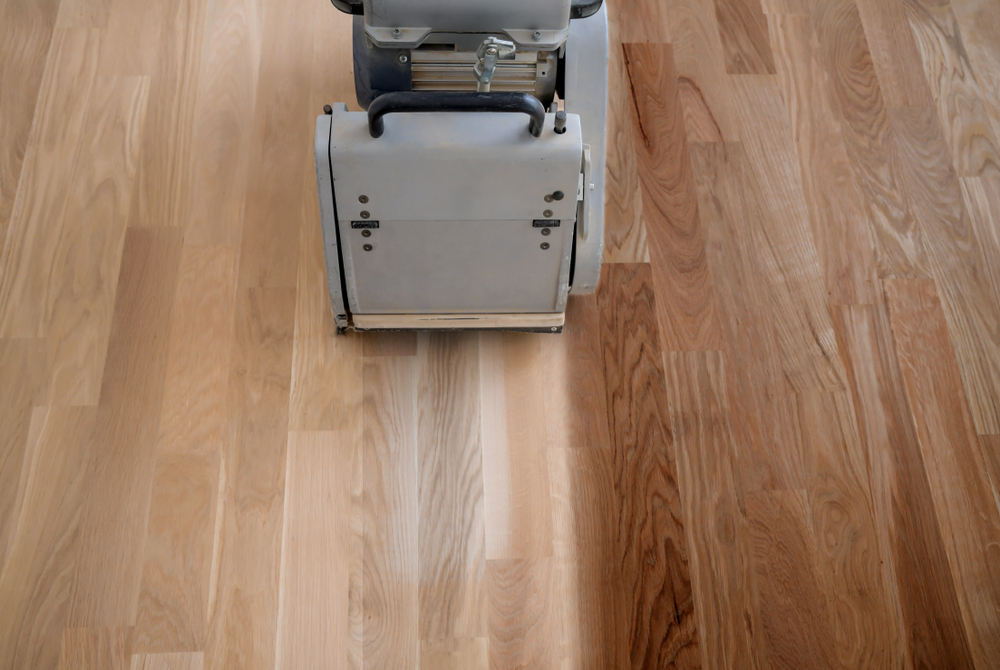
Surface scratches from pet claws, furniture moves, or daily foot traffic typically sand out completely during the refinishing process. Even deeper gouges often disappear with proper sanding technique. Dullness across large areas signals worn finish rather than wood failure – exactly what refinishing addresses.
Water stains and minor discoloration usually exist only in the finish layer or barely penetrate the wood surface. Professional sanding removes these imperfections while preserving the structural wood underneath. Gaps between boards that developed over time can be filled and sealed during refinishing.
The key test is wood thickness. Solid hardwood floors typically start at $3/4$ inch thick and can be sanded multiple times. If you can see the tongue-and-groove connections between boards, or if previous refinishing jobs left the wood noticeably thinner, you’re approaching the replacement zone. Most quality floors handle 6-10 refinishing cycles over their lifetime.
Age alone doesn’t disqualify floors from refinishing. Many Long Island homes have 50-100 year old oak floors that respond beautifully to restoration. The wood species, original quality, and maintenance history matter more than calendar years.
Certain types of damage can’t be fixed with refinishing, no matter how skilled your contractor. Recognizing these red flags saves you from wasting money on a refinishing job that won’t deliver lasting results.
Structural problems top the replacement list. Warped, cupped, or buckled boards indicate moisture damage that affects the wood’s integrity. These issues often extend below the surface layer that refinishing addresses. Similarly, floors that feel spongy, squeak excessively, or show significant movement when walked on suggest subfloor problems that require complete removal and reinstallation.
Water damage severity determines your options. Minor water stains often sand out, but extensive water exposure that turned wood black or gray usually penetrates too deeply for surface restoration. Mold growth, rot, or boards that have separated significantly typically mean replacement is your only viable path forward.
Previous refinishing history matters enormously. Floors refinished multiple times may lack sufficient wood thickness for another sanding cycle. If you can see nail heads, tongue-and-groove joints, or the wood measures less than $1/2$ inch thick, replacement becomes necessary for structural integrity.
Some engineered hardwood products can’t be refinished at all. Thin veneer layers – anything under $2 \text{mm}$ thick – won’t survive the sanding process. Floors with aluminum oxide factory finishes or certain polyurethane coatings may resist refinishing attempts entirely.
Money talks, especially when you’re weighing home improvement investments. Understanding the true costs of each option – including hidden expenses most homeowners miss – helps you make the financially smart choice.
Refinishing typically costs $\$3-8$ per square foot on Long Island, meaning a $1,000$ square foot area runs $\$3,000-8,000$ depending on your floor’s condition and finish preferences. Replacement costs $\$11-25+$ per square foot installed, putting that same $1,000$ square feet at $\$11,000-25,000$ or more.
The sticker price tells only part of the story. Both refinishing and replacement carry additional costs that can significantly impact your budget and decision-making process.
Refinishing projects often require furniture removal and storage, adding $\$20-50$ per room to your bill. You’ll need alternative living arrangements for 3-5 days while finishes cure, potentially including hotel costs. Some contractors charge extra for dustless refinishing systems, though the cleaner process often justifies the premium.
Preparation work can surprise you. Floors needing repairs before refinishing – replacing damaged boards, fixing squeaks, or addressing minor water damage – add $\$2-20$ per square foot depending on the scope. Stair refinishing costs significantly more per square foot due to the detailed handwork required.
Replacement projects carry their own hidden expenses. Removal and disposal of existing flooring adds $\$0.25-1.00$ per square foot. Subfloor repairs or leveling can cost $\$2-5$ per square foot if your existing foundation isn’t perfectly flat. New baseboards, quarter round, or trim work often becomes necessary, adding hundreds or thousands to your project total.
Don’t forget the opportunity cost. Refinishing typically disrupts your home for a week, while replacement projects can stretch 2-3 weeks depending on the scope. Lost productivity, temporary housing, or eating out more frequently during construction all impact your real project cost.
Smart homeowners think beyond immediate costs to consider long-term value and return on investment. The right choice today protects your investment for decades to come.
Refinishing delivers exceptional ROI when your floors have good bones. You’re essentially getting new-looking floors for $25-50\%$ of replacement cost, while preserving the character and quality of your original hardwood. Well-executed refinishing jobs last 10-15 years with normal use, making the cost per year extremely reasonable.
Quality refinishing actually increases your floor’s lifespan. The new protective finish shields wood from daily wear, moisture, and UV damage that would otherwise require more frequent maintenance. You’re not just restoring appearance – you’re investing in protection that extends your floor’s useful life.
Replacement makes financial sense when refinishing costs approach $60-70\%$ of new floor pricing, or when your existing floors lack the quality to justify preservation. New floors come with warranties, modern installation techniques, and the latest finish technologies that may outperform older restoration methods.
Consider your timeline too. If you’re planning to sell within 5 years, refinishing often provides better immediate return on investment. Buyers appreciate well-maintained original hardwood, especially in older Long Island homes where character matters. If you’re staying long-term, replacement might justify the higher upfront cost through decades of worry-free performance.
The environmental impact increasingly influences Long Island homeowners’ decisions. Refinishing preserves existing materials and reduces waste, aligning with sustainability goals while delivering cost savings. Replacement generates significant waste but provides opportunities to upgrade to more sustainable wood species or modern eco-friendly finishes.
The refinish versus replace decision comes down to honest assessment of your floor’s condition, realistic cost comparison, and alignment with your long-term goals. Most Long Island homeowners find refinishing delivers exceptional value when floors have good structural integrity and sufficient thickness for restoration.
Start with professional evaluation from experienced contractors who can assess your specific situation without sales pressure. The best choice varies by home, budget, and timeline – but armed with the right information, you can make the decision that protects your investment and delivers the beautiful floors your home deserves.
When you’re ready to move forward, we bring over 50 years of Long Island expertise to help you make the right choice and execute it flawlessly.