
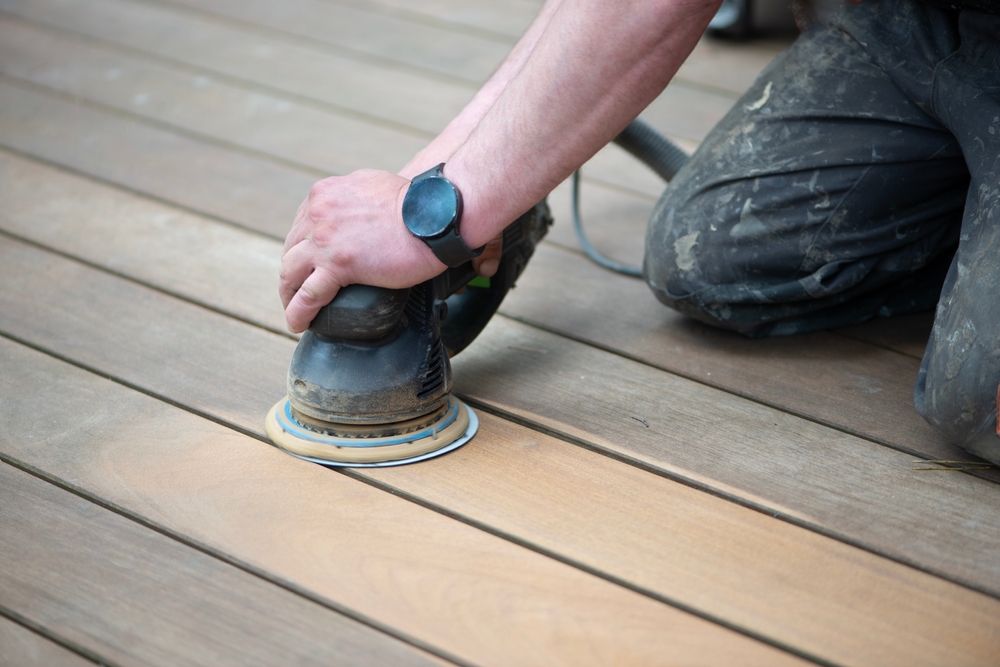
If you’ve been searching for “resurface hardwood floors” and ended up more confused than when you started, you’re not alone. The terms get used interchangeably by contractors, DIY sites, and home improvement forums — but they describe two very different processes with different costs, timelines, and outcomes. Choosing the wrong one wastes money. Worse, applying the wrong treatment to a floor that needed something else can leave you with a result that’s harder to fix than what you started with.
Here’s a straightforward breakdown of what each option actually means, how to tell which one your floor is asking for, and what makes Nassau County homes a little different when it comes to hardwood floors.
Wood Floor Refinishing vs. Resurfacing: What’s Actually Different
The confusion starts with the words themselves. “Refinishing” and “resurfacing” get used as if they mean the same thing — but depending on who you’re talking to, they can describe completely different jobs.
Full refinishing means sanding the floor down to bare wood, removing all the old finish, and starting fresh with new stain and topcoat. It’s the more involved process. It takes longer, costs more, and requires you to stay off the floors for a day or two while everything cures. But it’s also the only option if your floors have deep scratches, stains that have soaked into the wood, or a finish that’s peeling or completely worn through.
Resurfacing — sometimes called a screen-and-recoat — is a lighter approach. Instead of sanding to bare wood, the existing finish gets lightly abraded to help the new topcoat bond, then a fresh layer of finish is applied over it. It’s faster, less disruptive, and less expensive. The catch: it only works if the existing finish is still in reasonably good condition. If the finish underneath is failing, a recoat won’t hold.
How to Tell If Your Floors Need Refinishing or Just a Recoat
The honest answer is that a professional assessment is the most reliable way to know for sure — but there are a few things you can look at yourself before you pick up the phone.
Start with the scratch test. Run your fingernail across a worn area. If the scratch stops at the surface and doesn’t reveal raw, unfinished wood underneath, the finish is still intact and a recoat may be all you need. If you can see the bare wood through the scratch, the finish has worn through and you’re looking at a refinish.
Next, look at the high-traffic zones — the paths between rooms, the area in front of the kitchen sink, the stretch of floor near the back door. These are where the finish wears first. If those areas look dull or lightly scratched but the wood itself isn’t damaged, a recoat can bring them back. If the finish is completely gone and the wood looks dry or gray in those spots, that’s a refinish situation.
Color change is another clear indicator. If you want to go from a golden oak to a darker walnut stain, or lighten floors that have been stained for decades, you need a full refinish. There’s no way to change the color with a recoat — you’re just adding a clear layer over whatever’s already there.
One more thing worth knowing: if your floors have been recoated before and the finish is starting to peel or flake, that’s a sign the layers aren’t bonding properly. At that point, a recoat won’t fix it — you need to sand back to bare wood and start over. Applying another coat over a failing finish just adds to the problem.
The water-drop test is a simple way to check adhesion. Put a few drops of water on the floor. If it beads up, the finish is still sealing the wood. If it soaks in quickly, the finish is gone in that spot and the wood is unprotected — which usually means it’s time for a full refinish.
How Many Times Can You Refinish Hardwood Floors?
This is one of the most common questions we hear, and the good news for most Nassau County homeowners is that the answer is usually “more times than you think.”
Solid hardwood floors can typically be refinished anywhere from four to ten times over their lifetime. Each professional sanding removes about 1/32 of an inch of wood — a small amount that preserves the floor’s structural integrity when done correctly. The limiting factor is how much wood remains above the tongue-and-groove joint. Once you get below about 9/16 of an inch, sanding becomes risky.
Here’s why this matters locally: the majority of Nassau County homes were built during the post-World War II suburban boom — the late 1940s through the 1960s. Those homes were constructed with 3/4-inch solid hardwood floors, typically oak or pine. If your home is from that era and the floors haven’t been refinished more than once or twice, you almost certainly have plenty of wood left to work with. These floors were built to last, and most of them can handle several more refinishing cycles before you’d ever need to think about replacement.
Engineered hardwood is a different story. The refinishable surface on engineered floors is a thin veneer — sometimes as little as 2 to 4 millimeters. Most engineered floors can only be refinished once or twice, and some can’t be sanded at all without exposing the core material underneath. If your Nassau County home was built more recently — say, the 1990s or 2000s — there’s a reasonable chance you have engineered hardwood rather than solid, and that changes the calculus significantly.
If you’re not sure which you have, one way to check is to look at the edge of a floor vent or in a closet where the floor meets the wall. Solid hardwood will show a consistent wood grain all the way through. Engineered hardwood will show a thin surface layer over a layered core that looks more like plywood. When in doubt, have someone take a look before assuming either option is on the table.
Hardwood Floor Resurfacing in Nassau County: Why Local Climate Changes the Math
Nassau County isn’t a dry climate. The combination of Atlantic Ocean humidity on the South Shore, Long Island Sound moisture on the North Shore, and the swing between humid summers and dry heated winters puts hardwood floors through a real workout every year. Wood expands in summer and contracts in winter, and that constant movement accelerates finish wear in ways that don’t show up in national refinishing guides written for drier climates.
The standard recommendation is to refinish hardwood floors every seven to ten years. For many Nassau County homes — especially those in South Shore communities like Long Beach, Merrick, Freeport, Rockville Centre, and Massapequa — the realistic interval can be shorter. If you’re near the water and your floors get a lot of foot traffic, it’s worth checking them more often than that benchmark suggests.
South Shore Nassau County Floors: What Coastal Humidity Actually Does to Hardwood
Elevated humidity doesn’t destroy hardwood floors — but it does change how they age. In communities close to the water, wood absorbs more moisture during the summer months and then dries out significantly when the heat kicks on in winter. That repeated cycle of expansion and contraction puts stress on the finish, causing it to dull, crack, and wear through faster than it would in a drier environment.
You’ll often see this show up as finish failure in the middle of a room rather than just along the edges or in traffic paths. That’s a sign the wood itself is moving, not just that the floor is getting worn down by foot traffic. It’s a subtle but important distinction, because it tells you the finish is losing its bond — and that’s a situation where a recoat is unlikely to hold for long.
Post-Hurricane Sandy is also worth mentioning here. Many South Shore Nassau County homes had floors replaced or repaired after the 2012 flooding. Those replacement floors are now well over ten years old — right in the window where the finish starts to show its age and the first refinishing cycle becomes relevant. If your floors were put in around 2012 or 2013, it’s worth taking a closer look at where they stand today.
The other factor that comes up in older Nassau County homes, particularly those built before 1950, is pine plank flooring. Pine is softer than oak and more susceptible to denting and surface wear. It’s also trickier to sand and finish without creating uneven spots or blotching the stain — which is why a lot of contractors either avoid it or don’t get great results with it. It’s a specialty, and not every flooring company in Nassau County handles it well.
Frequently Asked Questions About Floor Resurfacing and Refinishing in Nassau County
**Is floor resurfacing the same as refinishing?**
Not exactly. Floor resurfacing typically refers to a screen-and-recoat — a lighter process where the existing finish is scuffed up and a new topcoat is applied without sanding to bare wood. Refinishing goes deeper: the old finish is completely removed by sanding, and the floor is restained and recoated from scratch. The right choice depends on the condition of your existing finish and what you want the end result to look like.
**How do I know if my hardwood floors can be refinished again?**
The key is how much wood is left above the tongue-and-groove. Solid hardwood floors need at least 9/16 of an inch remaining to safely allow another sanding cycle. If your Nassau County, NY home was built in the mid-20th century with original 3/4-inch solid hardwood, and the floors have only been refinished once or twice, you almost certainly have enough material left. A quick professional assessment will confirm it.
**Can I stay in my house while my floors are being refinished?**
For most projects, yes — though you’ll need to stay off the refinished areas until the finish has had time to cure. Light foot traffic is usually possible within 24 to 48 hours. Full curing, where the finish reaches its maximum hardness, takes longer — typically up to 30 days for complete durability. Modern dust containment equipment also makes the process far less disruptive than it used to be.
**How often should Nassau County homeowners refinish their hardwood floors?**
The national benchmark is every seven to ten years, but homes in Nassau County — particularly along the South Shore where humidity runs higher — may see finish wear on a faster cycle. High-traffic homes with kids and pets can sometimes need attention every two to five years. The best approach is to check your floors annually and look for the signs described earlier in this guide rather than waiting for a fixed number of years.
**What about engineered hardwood — can it be refinished?**
Most engineered hardwood can be refinished at least once, and some products with thicker wear layers can handle two cycles. The wear layer needs to be at least 1.5 millimeters thick to allow sanding. If you’re not sure what type of flooring you have or how much wear layer remains, it’s worth finding out before committing to either option.
What to Do Next When Your Nassau County Floors Need Attention
Most Nassau County homeowners with mid-century homes and original hardwood floors are in better shape than they realize. The floors under your feet were built to last, and in most cases they can be brought back — whether that means a light recoat or a full sand-and-refinish — without replacement ever entering the conversation.
The key is knowing what your floor is actually telling you before you call anyone. Check for scratches through to bare wood, look at the finish condition in your high-traffic zones, and think about when the floors were last refinished. That information will make any conversation with a contractor faster, clearer, and more useful.
If you’re not sure what you’re looking at or want a straight answer from someone who’s worked on Nassau County floors for years, we at KO Floors, Inc. offer free, no-obligation assessments — and we’ll tell you honestly what your floors need, not what costs the most.