
If you own a rental property in Nassau County, NY, you’ve probably replaced flooring more than you wanted to. Maybe it was carpet that held onto pet odors no amount of cleaning could fix. Maybe a tenant left and the floors looked like they’d aged ten years in two. Whatever the situation, the question is always the same: what do I put in next time that won’t cost me again in three years?
The answer isn’t as simple as “just get LVP” — and it’s not as complicated as you might think. Here’s a clear-eyed look at what actually holds up, what it costs over time, and what Nassau County landlords specifically should know before making a call.
Most Durable Flooring for Rental Properties: What the Numbers Actually Show
Durability in a rental isn’t just about scratch resistance — it’s about how many years you get before you’re back to square one. Carpet, which still shows up in a lot of Nassau County rental units, lasts roughly three to five years under real tenant conditions. That’s not a knock on carpet as a material. It’s just what happens when you factor in pets, spills, foot traffic, and the kind of wear that accumulates between leases.
Luxury vinyl plank, or LVP, has become the go-to recommendation across the industry for a reason. A quality product with a 20-mil or thicker wear layer will hold up for fifteen to twenty years in a rental setting. Professionally finished hardwood, depending on the species and the quality of the finish, can last far longer — and unlike any other flooring type, it can be sanded and refinished multiple times rather than replaced outright.
Why Nassau County Landlords Should Check What’s Under the Carpet First
Here’s something that comes up more often than people expect on Long Island: a landlord is ready to spend money on new flooring, and it turns out the best flooring in the room is already there — buried under thirty years of carpet.
Nassau County was largely developed between the 1940s and 1980s. A significant portion of the homes built during that era were constructed with solid red oak or white oak hardwood floors. At some point — often in the 1970s or 1980s — carpet became fashionable, and a lot of that original hardwood got covered over rather than replaced. It’s still there. And in many cases, it’s in better shape than you’d expect.
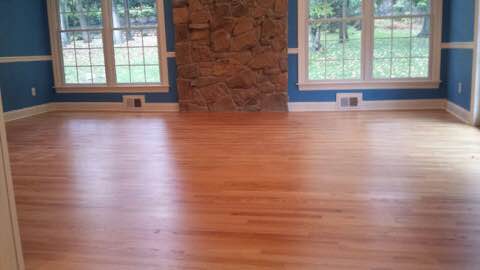
Before committing to new materials, it’s worth having someone pull up a corner and take a look. If the wood underneath is structurally sound, professional sanding and refinishing will restore it to a condition that looks genuinely new — and it will cost significantly less than installing new flooring across the entire property. We’ve walked into Nassau County rentals where the landlord was budgeting for a full LVP installation, and what was underneath made that conversation a lot simpler and less expensive.
This matters because refinished hardwood isn’t a compromise option. It’s a premium finish that photographs well for rental listings, appeals to the kind of tenant who’s paying $2,000-plus a month in this market, and holds up to normal rental wear when it’s properly coated. The finish is the key — a professional-grade polyurethane or oil-modified finish creates a surface that resists scuffs, cleans easily, and doesn’t trap odors the way carpet does.
Between tenants, a light buff and recoat is often all it takes to get the floors looking move-in ready again. The math here is straightforward. If you’re spending money on new flooring every time you turn over a unit, that cost compounds fast — especially when you factor in the vacancy days you’re carrying during installation. Refinishing existing hardwood eliminates the material cost entirely and typically takes less time to complete than a full floor replacement.
Waterproof Hardwood Flooring: Is It Actually an Option for Rentals?
The most common objection to hardwood in a rental is water. And it’s a fair concern — traditional solid hardwood and standing water do not get along. A toilet overflow, a pet accident that sits overnight, or a tenant who mops with too much water can cause cupping, swelling, or warping that requires more than a simple refinish to fix.
But the conversation has shifted. Waterproof hardwood flooring — specifically, engineered hardwood with a moisture-resistant core — is now a legitimate option for rental properties where you want the aesthetics and long-term value of real wood without the vulnerability of solid hardwood. Engineered hardwood is constructed with a real wood veneer on top of multiple layers of cross-ply material, which makes it dimensionally stable in ways that solid hardwood isn’t.
It handles the humidity swings that Nassau County summers bring — and Long Island summers are genuinely humid, with relative humidity regularly exceeding 70 to 80 percent from July through August — without the expansion and contraction issues that plague solid hardwood in less-controlled environments. For landlords who want real wood but are renting to tenants with pets or in units where moisture is a realistic concern, waterproof engineered hardwood sits in a useful middle ground.
It carries the visual appeal and resale value of hardwood, it can still be refinished depending on the thickness of the wear layer, and it performs better than solid hardwood in the conditions that actually exist in a Long Island rental. It’s also worth noting that the “hardwood gets ruined by tenants” assumption often has more to do with the quality of the finish than the wood itself. A properly applied, professional-grade finish on hardwood — whether solid or engineered — creates a surface that’s meaningfully more durable than what most landlords have experienced from a builder-grade installation or a floor that hasn’t been refinished in two decades.
Low Maintenance Flooring for Rentals: What “Easy to Manage” Actually Means
Low maintenance flooring for a rental property means something specific: it should be easy to clean between tenants, resistant to the kind of damage that requires professional repair, and capable of looking presentable without a lot of intervention. That last part matters more than people give it credit for. Floors that photograph well keep vacancy periods short.
In Nassau County’s rental market, where median rents sit around $2,082 a month, a unit that leases two weeks faster because the floors look sharp is a meaningful difference in annual income. LVP checks most of the low-maintenance boxes. Individual planks can be replaced if something gets damaged without redoing the whole floor. It cleans with a damp mop. It doesn’t hold odors. For landlords who want something they can essentially install and forget about for the better part of two decades, it’s a practical choice — particularly in kitchens, bathrooms, and any room where moisture is a realistic concern.
LVP vs. Hardwood for Rentals: Which One Costs Less Over Time?
This is the question most landlords are actually trying to answer, and the honest answer is that it depends on what’s already in the property and what your long-term plan is.
LVP installed runs roughly $3 to $7 per square foot. At $6 per square foot installed with a twenty-year lifespan, you’re looking at about $0.30 per square foot per year — one of the lowest cost-per-year ratios of any flooring option available. That’s a real number, and it’s why LVP has become the default recommendation for rental properties across the industry.
Hardwood installed runs $8 to $15 per square foot for new material. That’s a higher upfront cost, no question. But hardwood can be refinished four to six times over its life, and a solid hardwood floor can last fifty to a hundred years. If you already have hardwood in the property — which, again, is common in Nassau County’s older housing stock — you’re not paying for new material at all. You’re paying for refinishing, which is a fraction of the cost of replacement.
There’s also a resale argument that matters in this market. The National Association of REALTORS® has reported a 118% return on investment for hardwood flooring — meaning it returns more than it costs when the property sells. In a county where median home values are sitting around $704,400 and appreciating at roughly 8.7% per year, that’s not a small consideration for landlords who plan to eventually sell. LVP doesn’t carry the same resale weight.
The practical answer for most Nassau County landlords is something like this: if you have existing hardwood, refinish it. If you’re starting fresh in a moisture-prone area or a lower-price-point rental, quality LVP is the smart call. If you’re managing a higher-end rental where tenant expectations are high and resale value matters, engineered hardwood or refinished solid hardwood is worth the investment.
Common Questions Nassau County Landlords Ask About Rental Flooring
One question we hear often: is carpet ever the right answer for a rental? In most cases, no — and the math explains why. Carpet in a rental lasts three to five years. Replacing it means material cost, installation time, and vacancy days you’re paying for while the work gets done. At $1,500 to $3,000 a month in carrying costs during vacancy, even a short installation window adds up. Over the life of a property, carpet is almost always the most expensive flooring option despite its low upfront price.
Another common question: what about laminate? It’s priced similarly to LVP and looks similar on the surface, but there’s a meaningful difference — laminate is not waterproof. A single water incident, whether it’s a pet accident, a slow leak, or a tenant who mops too aggressively, can cause irreversible swelling at the seams. In a rental where you can’t control what happens day to day, that’s a real liability. LVP handles moisture without issue. Laminate doesn’t.
Landlords also ask about pets a lot — and for good reason. Roughly 72% of renters own pets. If your flooring choice rules out pet owners, you’ve significantly narrowed your tenant pool before you’ve even listed the unit. Professionally finished hardwood and quality LVP both hold up to pet traffic better than carpet, and neither one traps the odors that make a unit difficult to re-rent after a long tenancy.
One more thing worth addressing: the assumption that professional installation is only necessary for hardwood. It matters for LVP too. Subfloor preparation — leveling, moisture testing, proper underlayment — is what separates a floor that holds up for twenty years from one that starts showing problems in the first two. Click-lock LVP installed over an uneven or moisture-compromised subfloor will fail regardless of the quality of the product. The installation is part of the investment.
What’s the Right Flooring for Your Nassau County Rental Property?
There’s no single answer that works for every rental, but there is a framework that makes the decision clearer. Start with what you already have. If there’s hardwood under the current floor, find out what condition it’s in before spending money on new materials. If you’re starting from scratch, match the flooring to the unit — LVP for moisture-prone areas and budget-conscious replacements, engineered or refinished hardwood where tenant expectations and resale value justify the investment.
What’s consistent across all of it is that the cheapest upfront option is rarely the cheapest option over time. Flooring that lasts twenty years and cleans up between tenants in a day is worth more than flooring that costs half as much and needs replacing every lease cycle.
If you’re not sure what’s under your current floor or what makes sense for your specific property, we’re happy to take a look. KO Floors, Inc. has been working with Long Island homeowners and landlords for decades, and a free quote is the easiest way to find out where you actually stand before committing to anything.