
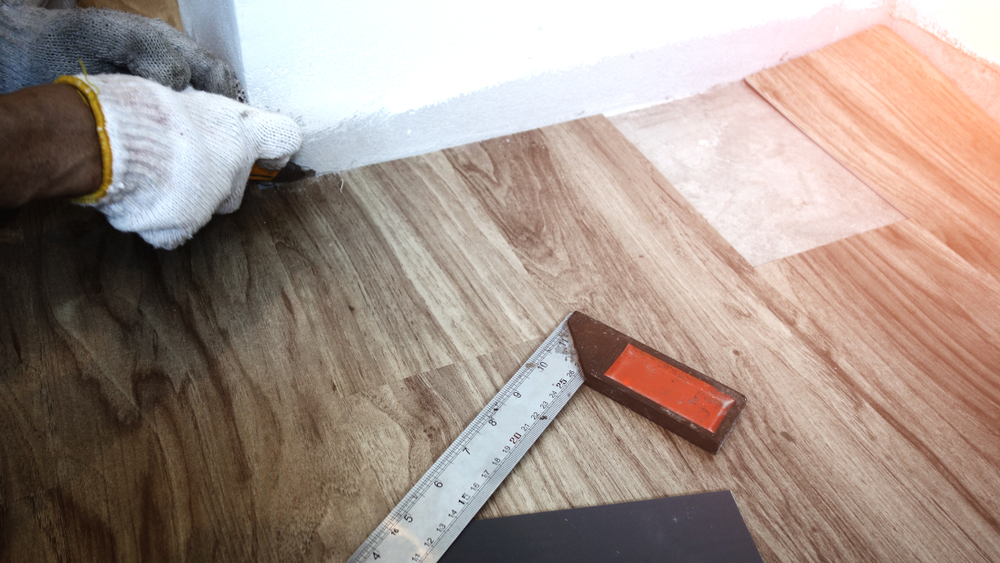
If you’ve been Googling hardwood floor replacement cost and landing on national averages that feel disconnected from reality, you’re not imagining it. Nassau County is not the national average. Labor costs more here, materials cost more here, and a quote that looks suspiciously low usually means something important is missing — underlayment, subfloor prep, or insurance.
Before you commit to tearing out your floors, it’s worth understanding what you’re actually working with. Most Nassau County homes have original hardwood that can be refinished — not replaced — and the cost difference is significant. Here’s what the numbers actually look like.
Average Cost to Refinish Hardwood Floors in Nassau County, NY
Nationally, hardwood floor refinishing runs roughly $3 to $8 per square foot. In Nassau County, expect to pay $4 to $9 per square foot for a standard sanding and refinishing job — more if you’re adding a custom stain, going with dustless equipment, or dealing with floors in rough shape.
For a typical 300 square foot room, that puts the total somewhere between $1,200 and $2,700. A full first floor in the 1,000 square foot range lands most Nassau County homeowners between $4,000 and $9,000.
Those numbers are higher than what you’ll see on Angi or HomeGuide, and that gap is intentional — not because local contractors are overcharging, but because the metro labor premium is real. A contractor quoting you $3 per square foot in Nassau County in 2026 is leaving something out.
Cost Per Square Foot to Refinish Hardwood Floors: What Drives the Price Up or Down
The per-square-foot rate is a starting point, not a final answer. Several factors push the number in either direction, and understanding them helps you evaluate quotes more accurately — especially when you’re getting bids from multiple contractors.
Floor condition is the biggest variable. Floors with light surface scratches, dullness, or minor discoloration are straightforward refinishing jobs. Floors with deep gouges, water staining, or boards that have started to cup or warp require more prep work and sometimes spot repairs before sanding can begin. That additional labor adds to the total.
Wood species matters too. Red oak and white oak — the most common species in Nassau County’s postwar housing stock — are workhorses. They sand predictably and accept stain evenly. Less common species, or floors with previous finishes that have built up over decades, take more time and more passes.
The finish itself is a cost factor. A standard two-coat oil-based polyurethane is less expensive than a three-coat water-based finish or a specialty product. If you want to change the stain color entirely — going from a golden honey tone to a dark walnut, for example — that adds time and materials. Dustless refinishing, which uses specialized equipment to contain the sanding dust rather than let it settle through your home, typically runs at the higher end of the range. For families with young children, people with allergies, or anyone who just doesn’t want to spend a week cleaning dust out of every corner of the house, it’s worth it.
Stair refinishing is another line item most homeowners don’t think about until they’re mid-project. If you’re refinishing the main floor of a colonial or split-level and your stairs connect directly to it, leaving the stairs untouched creates an obvious mismatch. Adding stair treads, risers, and handrail refinishing to the scope of work adds cost, but it’s far less disruptive — and less expensive — than trying to schedule it as a separate job later.
Minimum job charges are also a reality in this market. If you’re looking to refinish one small room or a hallway, some contractors have a floor on what they’ll take on. Bundling multiple areas into a single project almost always lowers your effective per-square-foot rate.
How Many Times Can Hardwood Floors Be Refinished Before They Need to Be Replaced?
This is one of the most important questions Nassau County homeowners can ask — and the answer is almost always more reassuring than they expect.
A standard ¾-inch solid hardwood floor can be sanded and refinished approximately six to eight times over its lifetime. Each sanding removes a thin layer of wood to get below the scratches and old finish. As long as there’s enough material left above the tongue-and-groove, the floor can be refinished again. The way to check: find a floor vent or a threshold where you can see the floor’s edge in cross-section. If the wood above the groove looks at least ¼ inch thick, you’re almost certainly a refinishing candidate.
Here’s why this matters specifically in Nassau County. The vast majority of homes built in the county between the 1940s and 1970s — the Capes, colonials, ranch homes, and split-levels that define the area’s residential landscape — were built with original ¾-inch solid oak floors. Many of those floors have been refinished once, maybe twice. That leaves four to six sandings of life remaining. In other words, the floor that looks beat up and dull to you right now may have another 40 or 50 years of useful life with the right refinishing job.
Full replacement becomes the right answer when the structural integrity of the floor is compromised — rot from prolonged moisture exposure, severe subfloor damage, boards that have buckled beyond what sanding can correct, or floors that have already been sanded down past the point of safe refinishing. Those situations exist, but they’re less common than most homeowners assume when they first start researching costs.
If you’re not sure where your floors fall, an in-person assessment is the only reliable way to find out. No contractor can give you an accurate answer from a photo or a phone call.
Hardwood Floor Replacement Cost on Long Island: When Refinishing Isn’t Enough
Full hardwood floor replacement — removing the existing floor and installing new material — costs significantly more than refinishing. In Nassau County, expect to pay $6 to $25 per square foot for a complete installation, depending on the wood species, subfloor condition, and the scope of demo work involved. Materials alone run $3 to $15 per square foot, with solid hardwood at the higher end of that range. Labor and removal add another $5 to $10 per square foot on top.
For a 1,000 square foot floor, that puts replacement somewhere between $11,000 and $25,000 or more. Refinishing the same floor runs $4,000 to $9,000. The math is hard to argue with — refinishing saves 50 to 75 percent compared to replacement when the floor qualifies. The question is always whether it qualifies.
Refinish vs. Replace: How to Make the Right Call for Your Nassau County Home
The refinish-versus-replace decision comes down to a few concrete factors, not a gut feeling about how bad the floor looks. Surface appearance is almost never a reason to replace. Scratches, dullness, worn finish, and even minor staining are exactly what refinishing is designed to address. The floor that looks like it needs to go is usually the floor that needs a good sanding.
The real replacement indicators are structural. If boards have rotted from water damage — a burst pipe, a long-term leak, or flooding — the wood itself is compromised and no amount of sanding will fix it. If the subfloor underneath has been damaged, that needs to be addressed before any surface work makes sense. If the floor has been sanded so many times that the boards are thin and the tongue-and-groove connection is at risk, refinishing isn’t safe and replacement is the right call.
There’s also a practical consideration for Nassau County homeowners who are preparing to sell. Refinished floors photograph beautifully and are one of the highest-return pre-sale improvements you can make. Real estate agents in the area consistently recommend floor refinishing before listing — it’s visible, immediate, and buyers respond to it. If the floors are structurally sound, refinishing before a sale almost always makes more financial sense than replacement, especially given the cost difference.
Nassau County’s South Shore homeowners — in communities near Long Beach, Atlantic Beach, and along the barrier island — deal with salt and sand tracked in from the beach more than most. That accelerates finish wear on hardwood floors. If your floors look dull and scratched despite being relatively young, the finish may simply be worn through from environmental exposure. That’s a refinishing job, not a replacement.
What to Look for When Hiring a Hardwood Floor Contractor in Nassau County
Getting the cost right starts with hiring the right contractor. In Nassau County, that means a few specific things.
First, verify that the contractor holds a valid Nassau County Home Improvement Contractor license through the Office of Consumer Affairs. This is a local requirement — separate from Suffolk County licensing and state-level credentials — and it’s one of the first things you should check. A licensed contractor carries accountability that an unlicensed one doesn’t.
Second, insist on an in-person assessment before any quote. Floor condition, wood species, finish history, subfloor integrity, and moisture levels all affect the scope and cost of the job. None of that can be evaluated accurately from a photo. Any contractor who quotes you without seeing the floor is guessing — and you’ll be the one absorbing the surprise charges later.
Third, understand what you’re comparing when you get multiple quotes. A quote that comes in significantly below the others isn’t necessarily a deal. On Long Island in 2026, a very low number almost always means something is being left out — proper subfloor prep, quality finish materials, or adequate insurance coverage. Nobody can do this work correctly in Nassau County for $4 per square foot. If the number looks too good, ask what’s not included.
Finally, ask whether the work is performed by our own team or subcontracted out. When the same people who gave you the quote are the ones doing the work, accountability stays in one place. When the job gets handed off to a subcontractor, quality control becomes harder to guarantee — and harder to resolve if something goes wrong.
We do all of our own work at KO Floors, Inc. Every project is handled by our in-house team — no subcontracting, no handoffs. When you get a quote from us, the people doing the job are the same people standing behind it.
Getting an Accurate Hardwood Floor Refinishing Cost Estimate in Nassau County
The honest answer to “what will this cost me” is that it depends on your floors — their condition, their history, their species, and what you want them to look like when the job is done. What we can tell you is that for most Nassau County homes with original hardwood, refinishing is the right call, and the cost is a fraction of what replacement runs.
If you’re in the research stage and trying to figure out whether your floors are refinishable, what a fair price looks like, or whether the quote you got is reasonable — a free, no-obligation in-person assessment is the fastest way to get real answers. No guessing, no pressure, no vague ranges.
Reach out to KO Floors, Inc. by phone, text, or the contact form on this site. We’ll come take a look and give you a straight answer.