
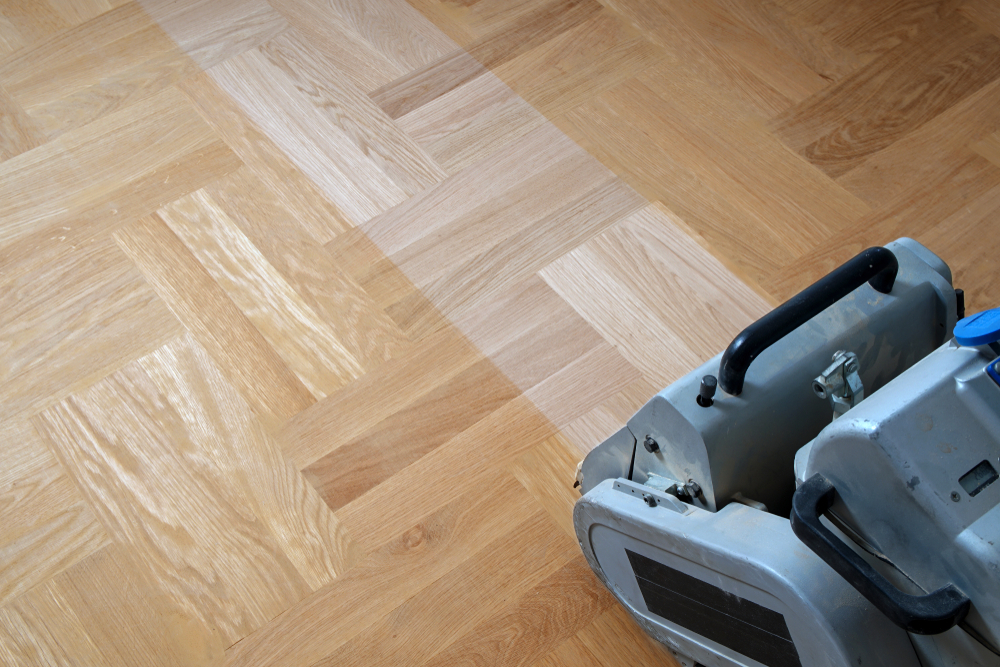
Most Nassau County homeowners don’t start researching hardwood refinishing because they want to. They start because something happened — the floors look bad, they’re selling the house, or they just pulled up old carpet and found original oak underneath. Now they’re getting quotes that are all over the place and trying to figure out what’s actually included.
That confusion is the norm, not the exception. Refinishing quotes are notoriously hard to compare because contractors scope jobs differently, use different products, and don’t always spell out what’s covered. We’ve been doing this work on Long Island since 1994, and we still hear it from homeowners every week. So let’s make it simple.
Cost to Sand and Refinish Hardwood Floors Per Square Foot
In Nassau County, the cost to sand and refinish hardwood floors typically runs between $3 and $8 per square foot for professional work. Where you land in that range depends on the condition of your floors, the species of wood, the finish type you choose, and whether any repairs are needed before sanding begins.
A standard sand-and-refinish on oak floors in good condition — the most common scenario in Nassau County homes — generally falls between $4 and $6 per square foot. That range assumes two to three coats of finish, light repairs, and a crew that knows what they’re doing. What it doesn’t always include is furniture moving, stair refinishing, or extra prep work on damaged boards — which is exactly why quotes from different contractors can look so different even when they’re describing the same job.
What Drives the Cost Up — and What’s Often Left Out of the Quote
The per-square-foot number is a starting point, not the whole story. Several variables can shift the final cost significantly, and the ones that cause the most frustration are the ones that don’t show up in the original quote.
Wood species matters more than most people expect. Common species like red oak and white oak — which make up the majority of original hardwood floors in Nassau County’s post-war housing stock — are on the lower end of the cost range, typically $3 to $5 per square foot to refinish. Harder or more sensitive species like mahogany require extra care to protect the grain and natural color, and can run up to $8 per square foot.
Floor condition is the other big variable. If your floors have deep scratches, water staining, or boards that have shifted or cupped over the years, those issues need to be addressed before sanding. Board-level repairs, re-nailing loose planks, and addressing subfloor moisture all add labor time and cost — but they’re also the difference between a floor that looks good for a year and one that holds up for decades.
Dustless sanding is another factor worth understanding. Most professional refinishers now use equipment that captures the vast majority of sanding dust at the source rather than letting it spread through your home. It’s better for your air quality, your HVAC system, and your family — especially in older homes where lead paint may be present on original surfaces. Dustless systems typically add $1 to $3 per square foot to the job, and in our experience, most Nassau County homeowners consider it worth it.
Finally, stairs. Refinishing a staircase is priced differently than open floor area because of the shape, the detail work, and the time involved. Expect to pay $40 to $75 per stair, depending on the profile and condition. If your quote doesn’t address the stairs separately, ask — because that’s one of the most common line items that gets added after the fact.
Cost to Remove Carpet and Refinish Hardwood Floors Underneath
This is one of the most common scenarios we encounter in Nassau County, and it deserves its own honest explanation. A huge portion of the homes built here between the late 1940s and early 1970s — the Levittown-era ranches, the Cape Cods, the split-levels throughout Hempstead, Massapequa, and Westbury — were originally built with solid oak hardwood floors. At some point, carpet got laid on top. Sometimes it was a style choice. Sometimes it was to cover damage. Either way, those floors are still there, and many of them are in better shape than you’d expect.
When a homeowner pulls up old carpet and finds original hardwood underneath, the first question is usually: can these be saved? The honest answer is: most of the time, yes — but you need a professional assessment to know for sure. The key factor is how much wood thickness remains. Solid hardwood floors can typically be refinished seven to ten times over their lifetime. If the floors were never refinished before, there’s a good chance they have plenty of life left.
The total cost for this kind of project breaks into two phases. Carpet removal typically adds $1 to $2 per square foot to the project before refinishing even begins, or roughly $150 to $300 per room depending on size. Then the refinishing itself runs $3 to $8 per square foot depending on condition and finish type. So for an average room — say 250 square feet — you might be looking at a total project range of roughly $1,000 to $2,500 once everything is factored in.
One thing worth knowing: if the carpet was installed in a home built before 1978, there’s a chance lead-based paint was used on the original floor surfaces or subfloor. Nassau County’s housing stock skews older, and this is a real consideration. A qualified contractor should assess for this before sanding begins. It’s not something to skip over.
Cost to Strip and Refinish Hardwood Floors vs. a Standard Sand-and-Refinish
Not every refinishing job is the same, and understanding the difference between a standard sand-and-refinish and a full strip-and-refinish can save you from either overpaying for something you don’t need or underpaying for a fix that won’t hold.
A standard sand-and-refinish works well when the existing finish has worn down evenly, the floor is in reasonably good structural condition, and you want to change the color or restore the original look. The process involves sanding down through the old finish to bare wood, applying stain if desired, and then laying two to three coats of new finish. This is the most common refinishing scenario and typically falls in the $3 to $8 per square foot range.
When a Full Strip-and-Refinish Is Actually Necessary
A full strip-and-refinish goes further. It’s the right call when the existing finish has failed in a way that sanding alone can’t fix — for example, when a previous contractor used an oil-based finish over a water-based one without proper preparation, or when there are multiple layers of old finish that have built up unevenly over decades. In these cases, the old finish needs to be chemically stripped before sanding begins, which adds both time and cost to the job.
You’ll also encounter this recommendation when floors have been refinished multiple times and the surface is no longer flat, or when previous refinishing work left visible swirl marks, blotchy staining, or uneven sheen. Stripping back to bare wood gives the floor a clean start and ensures the new finish bonds properly.
The cost to strip and refinish hardwood floors runs higher than a standard refinish — generally on the upper end of the $5 to $10 per square foot range — because of the additional labor and materials involved. It’s not always necessary, and any contractor who recommends it should be able to show you specifically why. If they can’t point to a concrete reason — failed finish adhesion, incompatible finish layers, or irreparable surface irregularity — it’s worth getting a second opinion.
In Nassau County, we see a lot of floors in older homes that have been refinished two or three times over the years, sometimes by contractors who used different finish types without testing for compatibility. That’s when a strip-and-refinish becomes the right call — not because it’s the more expensive option, but because it’s the one that will actually last.
Refinish vs. Replace: How to Actually Make the Call
This is the question most homeowners are really asking when they start getting quotes. And the honest answer is that refinishing wins the math in almost every realistic scenario — unless your floors are structurally compromised or have been sanded down so many times there’s no wood left to work with.
Here’s what the numbers look like side by side. Professional hardwood floor refinishing in Nassau County runs $3 to $8 per square foot. New hardwood floor installation — buying new material, removing the old floor, and installing from scratch — costs $6 to $25 or more per square foot depending on species, grade, and installation complexity. On a 1,000 square foot project, that’s a potential difference of $4,000 to $17,000 or more. In a county where the median home price regularly exceeds $600,000, that’s real money.
Refinishing also preserves what you already have. Original solid oak floors from the 1950s and 1960s — the kind found throughout Nassau County’s older neighborhoods — were milled from old-growth timber that’s denser and more durable than most of what’s available today. Replacing them with new material isn’t necessarily an upgrade. In many cases, it’s a step down in quality dressed up in new finish.
The cases where replacement makes more sense are specific: floors that have been sanded so many times the boards are thin and uneven, significant water damage that has warped or buckled the subfloor, or structural repairs that require pulling up sections of flooring anyway. Outside of those situations, refinishing is almost always the smarter financial decision — and it typically delivers results that are indistinguishable from new.
What matters most when comparing bids isn’t just the per-square-foot number. It’s what’s actually included. Ask every contractor you speak with exactly how many coats of finish are in the quote, whether furniture moving is covered, how they handle repairs discovered during sanding, and what products they’re using. Those details are where bids diverge — and where the real cost comparison lives.
Finding the Right Hardwood Refinishing Contractor in Nassau County
The cost to refinish hardwood floors is only part of the picture. The bigger question is whether the contractor you hire is going to be straight with you about scope, show up when they say they will, and deliver a result that holds up.
Nassau County homeowners tend to do their homework — and they should. Verify that any contractor you’re considering holds a Nassau County Department of Consumer Affairs Home Improvement Contractor License. Ask for references. Ask what products they use and how many finish coats are included. If a quote seems unusually low, find out why before you sign anything.
We’ve been refinishing hardwood floors on Long Island since 1994, and our team brings more than 50 years of combined experience to every job — from original oak floors uncovered under decades of carpet in Massapequa, to antique floor restoration in Great Neck, to full refinishing projects in homes throughout Nassau County and Suffolk County. If you’re trying to figure out whether your floors are worth refinishing, or you’ve been getting quotes that don’t add up, reach out to KO Floors, Inc. for a free, no-obligation assessment. We’ll tell you exactly what we see — and exactly what it will cost.