
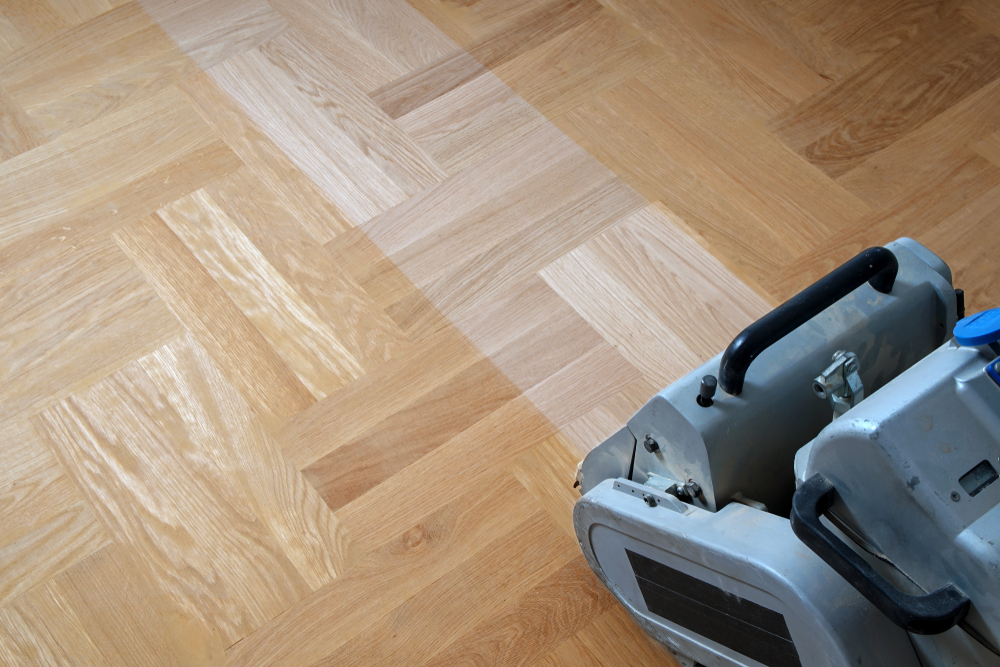
Your floors are dull. There’s a grayish lane down the hallway where everyone walks, and scratches by the back door where the dog, the kids, and half the beach come in. One person tells you a screen and recoat will fix it. Another says you need a full sand. Both sound confident, and the price gap between them is big enough that guessing wrong stings.
The good news is that you can figure out most of this yourself in a few minutes, with a glass of water and your fingernail. First, let’s be clear about what a screen and recoat actually is.
What A Hardwood Floor Screen And Recoat Does (And Doesn’t Do)
A screen and recoat, sometimes called a buff and coat, is a light scuffing of your floor’s existing finish followed by a fresh coat of finish on top. The scuffing is done with an abrasive screen, and its only job is to give the new coat something to grab. It takes off a tiny bit of the old finish and none of the wood.
That’s why it works well on a floor that’s dull but sound, and why it can’t do certain things. Because it never reaches bare wood, it can’t change your stain color, and it can’t erase deep scratches or fix worn-through spots.
Plenty of people hear “light sanding” and picture something that will freshen or lighten the whole look of the floor. It won’t. A recoat restores the protective layer. Restoring everything underneath it takes a full sand and refinish.
How Do I Know If My Floor Needs A Recoat Or A Full Sanding?
Here are four checks you can do tonight, no tools needed.
First, drip a little water on a worn-looking spot, like the hallway or the area in front of the kitchen sink. If it beads up, the finish is still doing its job. If it soaks in right away or darkens the wood, the finish is gone in that spot.
Second, run your fingernail across a scratch. If it glides over, the scratch is in the finish, and a recoat can often handle it. If your nail catches, the damage is probably down in the wood, and a recoat would just lay a new layer over the same groove.
Third, look for gray, pale, or dark patches, especially near doors, under windows, and around plant pots or pet bowls. Those usually mean bare wood or moisture, and a recoat can’t cover that up. That’s sanding territory.
Fourth, and this is the one people skip, ask yourself whether you want a different color. If you want that reddish tone from the previous owner to go lighter, no amount of screening will get you there. Color is in the wood itself, so changing it takes a full sand and refinish.
If you pass all four, you’re probably a recoat candidate. If you fail one, you may still be fine in some rooms and need sanding in others, which is common in a house where the entryway takes a beating and the dining room barely gets walked on. That’s the part we’d rather see in person than guess at. Wood species, finish type, and remaining wear layer don’t show up well in a phone photo.
How Many Sandings Does A Long Island Oak Floor Have Left?
A lot of Nassau County homes built after the war (in places like Levittown, Massapequa, Rockville Centre, and Valley Stream) went in with solid three-quarter-inch hardwood, often red oak. Those boards can take several sandings over a lifetime, but not an unlimited number. Each full sand removes roughly 1/32 to 1/16 of an inch of wood. Sand every time the floor looks tired, and eventually you run out of wood.
That’s the real case for a maintenance coat. A screen and recoat done while the finish is still mostly intact adds protection without spending any of the wood. National Wood Flooring Association guidance suggests a maintenance coat about every three to five years, depending on traffic, pets, and kids. Floors that get coated on that rhythm can often go much longer between full sands.
If your floor has already been sanded a few times (say an older Levittown Cape, a Merrick ranch, or a Garden City colonial) the math matters even more. Factory-finished flooring is a different story: the same NWFA guidance puts the minimum remaining wear layer for sanding at about 2.5 mm, or 3/32 of an inch. Go thinner than that and sanding may not be an option, which makes timely recoating the main way to keep the floor going.
None of this means sanding is the enemy. When the finish has failed, when there’s bare wood, or when you want a new color, sanding is the right job, and dodging it only buys you a recoat that won’t hold. The goal is to avoid spending wood you don’t have to. We’d rather look at your boards, tell you what’s left, and let you decide with real information.
How We Handle A Hardwood Floor Screen And Recoat On Long Island
We start with a conversation and a walk through the house, not a number. We look at the floor in daylight, check how worn the traffic lanes are, and work out what finish is on there. If there’s any chance of wax or old oil soap residue, that matters, because new finish doesn’t bond well over either. We’ll test a small, out-of-the-way spot before anyone commits to a whole-room recoat.
If a recoat makes sense, the floor gets cleaned thoroughly, screened, vacuumed, and coated. We can handle moving furniture out and back in too. And if your answer turns out to be a refinish, we put stain samples right on your own floor, so you’re choosing color from your actual boards instead of a chip under showroom lights.
Long Island Humidity And Beach Sand: How They Change The Recoat Decision
Long Island floors live a double life. Summers are humid, with indoor humidity often sitting around 60 to 75 percent in July and August. Winters are cold and dry, and forced-air heat can pull indoor humidity down to 20 or 30 percent. Wood moves with that swing, so you get gaps between boards in January, cupping in August, and a squeak or two in between.
Here’s why that matters for this decision. A recoat won’t close a gap or flatten a cupped board. If your floor looks rough mostly because the boards are moving, new finish will make the problem shinier, not solve it. Sometimes the honest answer is to see how the floor settles through the seasons before you spend anything.
Then there’s the grit. If you live near the Sound or the South Shore (in a town like Kings Park, NY or Babylon, NY where sand comes home in everyone’s shoes) it works like sandpaper on your finish. Entryways, kitchens, and hallways can wear out sooner than the three-to-five-year guideline suggests. That’s also why recoating the whole house on one schedule can backfire. If a couple of rooms really need sanding and the rest only need a coat, you end up with a mismatch. We look room by room.
Older homes add one more wrinkle. Decades of floor care products, a past wax job, or an oil soap cleaner can leave a film that keeps new finish from bonding. NWFA guidance also warns that the wrong cleaners can complicate recoating and even void finish warranties, so what’s been used on your floor matters as much as how it looks.
Screen And Recoat vs. Refinishing: Questions Long Island Homeowners Ask Us
How often should I screen and recoat? NWFA guidance points to roughly every three to five years, with busy entryways and homes with pets or kids on the shorter end. If sand and grit come in with you every day on Long Island, plan for the shorter end.
Will it peel? It can if the prep gets skipped. Finish applied over wax, oil soap residue, or dirt doesn’t bond, which is why we test before we commit. Be wary of any quote for a recoat given sight unseen.
Can you recoat over scratches or pet stains? Fine surface scratches, yes. Deep scratches your fingernail catches in, and dark pet stains that have gone into the wood, no. Those need sanding.
Is it cheaper than refinishing? Usually a recoat costs a fraction of a full refinish and is less disruptive. We’ll price your floor after we’ve seen it, because size and condition change the answer.
How long until I can walk on it? That depends on the finish and the weather. Humid July days slow drying on Long Island, so be skeptical of anyone promising a no-dust, no-odor job or an exact hour you can move the furniture back. Ask how long your specific job will take.
How do I know a contractor is legitimate? In Suffolk County, flooring counts as home improvement work that requires a license, and a few East End towns have their own requirements on top of that. Ask anyone you’re considering, us included, for their license and proof of insurance.
Screen And Recoat Or Refinish Your Hardwood Floors On Long Island? Start With A Look
So here’s the short version. If your finish is dull but intact, your scratches are shallow, and you like your color, a screen and recoat can restore the floor and save wood for later. If you’ve got gray spots, deep scratches, or a color you want gone, you’re looking at a full sand and refinish, and a recoat would only delay the inevitable.
If you can’t tell which side you’re on, that’s where we come in. KO Floors, Inc. is a family-run hardwood crew based in Huntington, working in homes and businesses across Nassau and Suffolk, with decades of hands-on experience behind us. Give us a call or send a message, and we’ll look at your floor, test it, and tell you straight what it needs, even when the answer is the smaller job.