
Most people don’t go searching for industrial flooring contractors because they woke up one morning and decided it was time. Usually, something happened. A floor started peeling. A concrete slab cracked. A new lease came with bare concrete and no plan. Or maybe a health inspection flagged a surface that wasn’t holding up anymore.
Whatever brought you here, the real question isn’t just “who do I call?” — it’s “do I even need a specialist, or will any flooring contractor do?” That distinction matters more than most people realize, and getting it wrong is expensive. Here’s what you actually need to know.
Industrial Flooring Solutions: What They Are and When You Actually Need Them
Industrial flooring isn’t a product — it’s a category of systems designed to hold up under conditions that would destroy standard flooring in a matter of months. We’re talking about spaces with heavy foot traffic, machinery, chemical exposure, moisture, or surfaces that need to stay clean and seamless without constant maintenance.
The confusion comes from the word “industrial.” A lot of people hear that and think factories only. But the reality is that industrial-grade flooring systems are the right call for commercial kitchens, medical offices, auto shops, retail showrooms, warehouses, and yes — even home offices that see serious daily use. The trigger isn’t the industry you’re in. It’s what your floor actually has to survive.
What Makes a Space Require Industrial-Grade Flooring?
There are a few clear signals that a standard residential flooring contractor isn’t the right fit for your project. The first is substrate. If your space has a concrete slab as its base — which is true of most commercial, industrial, and many basement-level spaces across Nassau County — you’re already in specialist territory. Concrete needs to be properly prepared before any coating goes down, and that preparation is where most flooring failures begin.
The second signal is use. If your floor is going to see forklifts, heavy equipment, rolling carts, commercial kitchen traffic, or even just hundreds of people walking through every day, a consumer-grade product will not last. The difference between a floor that holds up for fifteen years and one that starts peeling in two comes down to the system — specifically, the solids content of the coating, the number of coats applied, and how thoroughly the concrete was prepared before anything touched it.
The third signal is environment. Nassau County’s coastal position creates a specific challenge that doesn’t apply everywhere: moisture vapor transmission. Concrete slabs in coastal communities — particularly along the South Shore in places like Freeport, Oceanside, and Long Beach — absorb and release moisture in ways that can destroy a coating applied without proper moisture testing and a mitigation primer underneath. A contractor who skips that step isn’t cutting corners on aesthetics. They’re cutting corners on the one thing that determines whether your floor lasts.
Chemical exposure is the fourth trigger. If your space involves oils, solvents, cleaning agents, or food acids — commercial kitchens being the obvious example — you need a system that’s chemically resistant by design, not just by accident. Urethane cement systems exist specifically for this reason. Standard epoxy won’t survive a commercial kitchen environment long-term, and no amount of mopping will change that.
If any of these conditions apply to your space, you’re looking at industrial flooring territory — regardless of whether you’d describe your business as “industrial.”
Why Surface Preparation Separates Real Specialists from Everyone Else
Here’s the part that most contractors don’t talk about, because it’s not glamorous and it’s not quick. Surface preparation is the single most important factor in how long an industrial floor coating lasts. Not the brand of epoxy. Not the color. Not the number of coats. The prep.
Proper mechanical surface preparation — specifically diamond grinding — opens up the concrete at a microscopic level so the coating can bond to it permanently. It removes surface contaminants, levels out inconsistencies, and creates the profile the coating needs to adhere. When a contractor skips this step or substitutes it with acid etching, they’re applying a coating to a surface that was never properly prepared to receive it. The result looks fine for a while. Then it peels.
This is why the question “how do you prepare the surface?” is the single best question you can ask any contractor you’re considering. A professional will describe their mechanical grinding process without hesitation. Someone who gives you a vague answer or pivots immediately to talking about the coating itself is telling you something important.
At KO Floors, Inc., we use mechanical diamond grinding on every concrete surface before any coating goes down. It’s not optional for us — it’s the foundation of everything else. We also conduct moisture testing before application, which is especially critical for Nassau County spaces near the water or with below-grade slabs. A polyaspartic topcoat applied over an unaddressed moisture problem is just a delayed failure. We’d rather catch it at the start.
The coating system matters as much as the prep. Our 4-Layer Epoxy Flake Floor System uses an industrial-grade polyaspartic topcoat — not a standard epoxy finish. Polyaspartic cures faster (most floors can be walked on within 24 hours), resists UV yellowing, and holds up to abrasion better than conventional epoxy. For Nassau County businesses that can’t afford extended downtime, that fast return-to-use timeline is often a deciding factor.
Best Flooring for Office Spaces: Where Industrial and Commercial Overlap
Not every flooring question involves a warehouse. A growing number of calls we get are from Nassau County business owners renovating office spaces — particularly along the Garden City and Jericho corridors — who want something more durable and more interesting than carpet or standard tile.
The good news is that the same systems used in industrial environments translate beautifully to commercial office settings. Polished concrete, metallic epoxy, and epoxy flake systems are all showing up in modern offices, and for good reason — they’re seamless, easy to maintain, and they look like a deliberate design choice rather than a default.
Modern Office Flooring Trends Nassau County Businesses Are Actually Using
The shift toward industrial-aesthetic office flooring has been building for years, and it’s accelerated significantly since businesses started renovating to bring employees back post-COVID. In Nassau County’s Class A office market — particularly in Garden City, Mineola, and the office parks along the Long Island Expressway corridor — polished concrete and metallic epoxy are showing up in reception areas, open workspaces, and common areas where the floor used to be an afterthought.
There’s a practical reason behind the trend, not just an aesthetic one. Polished concrete and epoxy systems require almost no ongoing maintenance compared to carpet or traditional tile. No grout lines to scrub. No fibers to trap allergens. No sections to replace when one area wears out faster than another. For a property manager or business owner trying to reduce operating costs, that’s a real argument — not just a design preference.
For reception areas and client-facing spaces, metallic epoxy creates a one-of-a-kind floor that no two installations replicate. For open-plan offices with high foot traffic, an epoxy flake system with a polyaspartic topcoat gives you the durability of an industrial floor with a finish that looks intentional. For spaces that need warmth — conference rooms, private offices, executive suites — hardwood still wins, and that’s where our hardwood division comes in. We can handle both in the same building, which is something most flooring contractors genuinely cannot offer.
Best Flooring for a Home Office: What Nassau County Remote Workers Are Choosing
Nassau County has one of the highest concentrations of remote and hybrid workers on Long Island, and the home office flooring question has become a real one — not a hypothetical. If you’re spending forty hours a week in a dedicated workspace, the floor matters. It affects how the room sounds on video calls, how it feels underfoot during long days, and honestly, how professional the space looks when your camera is on.
The most common mistake we see is people treating the home office like any other room and defaulting to whatever flooring they already have — which is often carpet that absorbs sound but looks dated, or cold tile that’s easy to clean but uncomfortable for long hours. Neither is the right answer for a space that’s functioning as a professional environment.
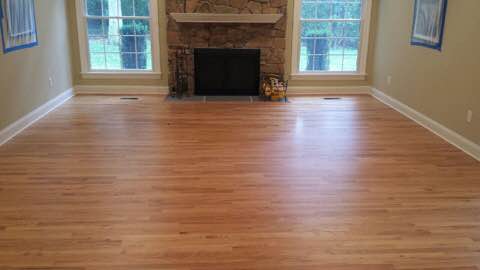
Hardwood is the most popular choice for home offices in Nassau County, and it makes sense. It’s timeless, it photographs well, it adds real value to the home, and it holds up to the kind of daily use a dedicated workspace gets. Wide-plank hardwood in particular has become a go-to for home offices that need to look polished without feeling corporate. Our team has been installing and refinishing hardwood across Nassau County for decades, and we can match new flooring to existing floors elsewhere in the home — even in older houses where the original floors have seen better days.
For homeowners who want something more modern or who are working with a below-grade space like a finished basement, luxury vinyl plank is worth considering — it’s waterproof, durable, and significantly more comfortable underfoot than tile. And for the homeowner who wants a genuinely distinctive floor that becomes a conversation piece on every video call, a metallic epoxy system in a home office or studio space is an option almost no one else is offering in this market.
The best flooring for your home office depends on how you use the space, what’s already there, and what matters most to you — durability, warmth, acoustics, or aesthetics. We’re happy to talk through the options without any pressure to go in a particular direction.
How to Choose the Right Industrial Flooring Contractor in Nassau County
The short version: ask about surface preparation first. Any contractor worth hiring will tell you exactly how they prepare the concrete and what products they’re using. If that answer is vague, move on.
Beyond that, look for a contractor with verifiable experience in spaces like yours, a clear written scope of work, and a warranty that covers both materials and workmanship. Nassau County’s coastal conditions — the humidity, the freeze-thaw cycles, the moisture issues that come with proximity to the water — make it especially important to work with someone who understands the local environment, not just flooring in general.
We’ve been serving Nassau County for years, and we bring over 50 years of combined team experience to every project — residential hardwood, commercial epoxy, and everything in between. If you’re trying to figure out what your space actually needs, reach out for a free, no-obligation quote. We’ll give you a straight answer.