
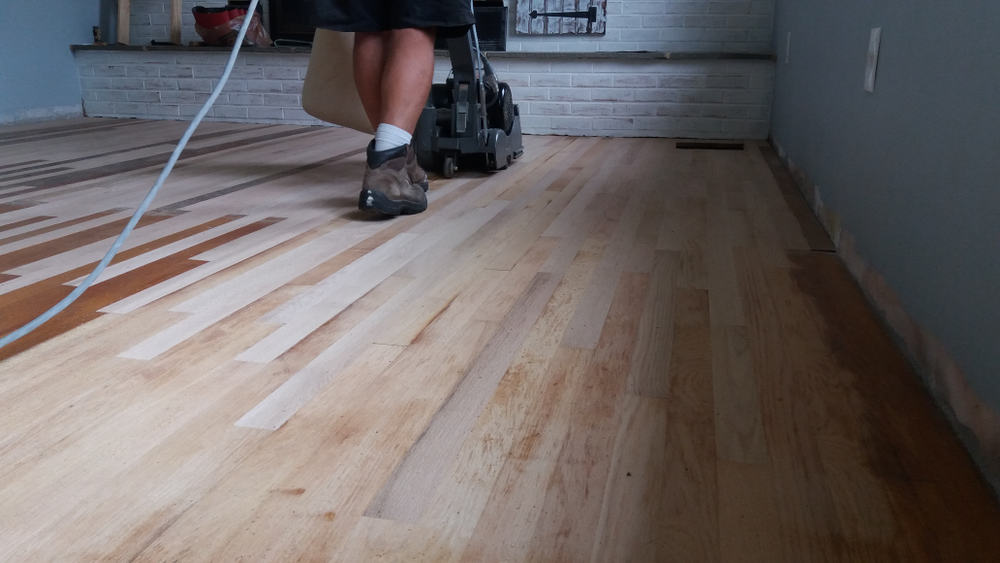
If you’ve been going back and forth on whether your engineered hardwood floors can be refinished, you’re not alone. It’s one of the most common questions we hear from Nassau County homeowners — and one of the most poorly answered ones online. Some sites say yes, some say no, and most don’t explain why. The real answer is: it depends on your wear layer. Once you understand what that means, the whole decision gets a lot clearer. Here’s what you actually need to know before you call anyone, get a quote, or start second-guessing whether you need a full replacement.
Can You Refinish Engineered Hardwood? It Starts With One Number
Engineered hardwood is built differently than solid hardwood. It has a real wood veneer on top — the part you see and walk on — bonded to layers of plywood or high-density fiberboard underneath. That top layer is called the wear layer, and its thickness is the only thing that determines whether your floor can be sanded and refinished.
Wear layers on engineered hardwood range from as thin as 0.5mm to as thick as 6mm depending on the product. The thicker that top layer, the more refinishing cycles the floor can handle. The thinner it is, the fewer options you have. The National Wood Flooring Association is clear on this: floors with a wear layer under 3/32 of an inch should not be sanded at all.
What Wear Layer Thickness Actually Means for Your Floor
Here’s the practical breakdown. Each time a floor is sanded, it loses roughly 1/32 to 1/16 of an inch of material. That’s not much — but on a floor with a thin wear layer, it’s everything. Sand too deep and you’re into the plywood core, which means the floor is done. There’s no coming back from that.
A wear layer around 1mm or less cannot be sanded at all. At that thickness, the only option is a surface-level refresh, not a true refinish. A 2mm wear layer gives you one careful sanding over the floor’s lifetime — that’s it. Move up to 3mm and you’re looking at two or three refinishing cycles. Floors with 4mm to 6mm wear layers are the most versatile; some can be refinished multiple times and behave almost like solid hardwood in that regard.
This is why the question “can you refinish engineered hardwood floors?” doesn’t have a single yes-or-no answer. It genuinely depends on the product. A premium engineered floor installed during a high-end renovation in Garden City, NY in 2002 might have a 5mm wear layer and be a great candidate for refinishing today. A builder-grade floor from a quick flip in Levittown, NY might have a 1mm veneer that’s already at its limit.
The only way to know for sure is to have someone measure it. A visual inspection won’t tell you — you need to look at the product specifications or have an experienced flooring contractor assess it in person. That’s exactly what we do before recommending any course of action. We don’t assume every engineered floor can be sanded, because that assumption is what leads to irreversible damage.
What makes this especially relevant for Nassau County homeowners right now is timing. A significant number of homes here were renovated in the late 1990s and early 2000s, when engineered hardwood became the go-to choice for its stability in coastal climates. Those floors are now 20 to 25 years old. For floors with a 3mm or thicker wear layer, that’s right in the window where a first refinishing makes sense — and waiting longer only narrows your options.
How to Tell If Your Engineered Floor Has Been Refinished Before
If you bought your home and don’t know the floor’s history, this matters. A floor that’s already been sanded once has less wear layer remaining than a floor that hasn’t been touched since installation. And if a previous contractor sanded too aggressively — which does happen — you may have even less to work with than the original specs would suggest.
There are a few signs that a floor has been previously refinished. Look at the edges near the baseboards or in a closet where the floor meets the wall. If the floor sits noticeably lower than the baseboard, or if you can see a visible step where the floor transitions to an adjacent room, that’s a sign material has been removed. You might also notice that the beveled edges between planks have been partially filled in or look shallower than they should — another indicator that the surface has been sanded down.
None of this is a definitive test, but it gives you useful information going into an assessment. The more accurate approach is to pull a floor vent cover and look at the cross-section of the plank from the side — you can often see the wear layer as a distinct top band above the core layers. If it looks thin, it probably is.
We’ve worked on Long Island floors for over 50 years, and the post-war housing stock in Nassau County — the Cape Cods in Massapequa, NY, the colonials in Syosset, NY, the ranches in Bethpage, NY — has been through a lot. Some of these homes have had their floors touched multiple times by multiple contractors over the decades. Knowing that history, or at least being able to read the physical evidence, is part of what separates a proper assessment from a guess.
If there’s any uncertainty about your floor’s refinishing history, that’s not a reason to avoid calling. It’s actually the best reason to get an expert opinion before committing to anything.
Sandless Hardwood Floor Refinishing: The Option Most Homeowners Don’t Know About
Here’s where a lot of homeowners get stuck. They find out their wear layer is thin, assume refinishing is off the table entirely, and start pricing out full replacement. That’s an expensive conclusion to jump to — because there’s a middle option that genuinely works for a lot of engineered floors.
It’s called screen and recoat, or sandless refinishing. Instead of sanding down to bare wood, a light abrasion is applied to scuff the existing finish layer, then a fresh topcoat is applied over it. No wood is removed. The floor looks refreshed, the finish is renewed, and the wear layer stays intact.
When Screen and Recoat Is the Right Call for Engineered Floors
Screen and recoat is the right move in a few specific situations. If your wear layer is too thin for full sanding, it’s often your best — and only — refinishing option short of replacement. It’s also a smart choice for floors that are in decent overall condition but look dull, scuffed, or worn on the surface. If the finish has broken down but the wood itself isn’t damaged, you don’t need to sand. You just need a new topcoat.
The tradeoff is that sandless refinishing has real limitations. It won’t fix deep scratches that have cut into the wood. It won’t change your floor’s color — since you’re not removing the existing stain layer, the color stays as-is. And it won’t address boards that are warped, cupped, or structurally compromised. For those issues, you need either full sanding (if the wear layer allows) or replacement.
But for the large number of Nassau County homeowners with 1990s and early 2000s engineered floors that have surface wear but are otherwise sound, screen and recoat can extend the floor’s life by several years without touching the wear layer at all. The NWFA actually recommends this as a maintenance step every three to five years depending on foot traffic — not just as a last resort, but as a proactive way to protect the floor between full refinishing cycles.
Long Island’s coastal humidity plays a real role here. The seasonal swings between hot, humid summers and dry, heated winters put stress on floor finishes over time. That surface breakdown you’re seeing on your floors isn’t just age — it’s also the climate doing its work. A fresh topcoat applied at the right time can prevent that surface wear from progressing into actual wood damage, which is a much more expensive problem to solve.
Buffing Hardwood Floors: What It Is and When It Actually Helps
You’ll sometimes hear the term “buffing” used alongside screen and recoat, and it can mean slightly different things depending on who’s saying it. In most contexts, buffing hardwood floors refers to the same general process — using a buffer or floor machine with a fine abrasive pad to lightly scuff the existing finish before applying a new coat. It’s the mechanical step that helps the new finish bond properly to the old one.
On its own, buffing without recoating doesn’t do much. It might remove a thin layer of surface grime and give the floor a temporary shine, but without a new finish applied afterward, the results won’t last. The combination — buff the surface, then recoat — is what actually refreshes the floor.
For engineered hardwood specifically, this approach is valuable precisely because it doesn’t touch the wood. The buffer works on the finish layer only. That means it’s safe for floors where any sanding would risk cutting through the veneer, and it’s also significantly less disruptive than full refinishing. Floors are typically walkable within hours rather than days.
In Nassau County, where a lot of homeowners are managing busy households and can’t realistically vacate for a week, that matters. We hear this from clients regularly — the idea of traditional refinishing feels like too much disruption. Screen and recoat sidesteps most of that. There’s no heavy sanding dust, no extended dry time, and no need to move every piece of furniture out of the house for days on end.
Not every floor needs full sanding, and pushing for it when it isn’t necessary doesn’t serve you. If buffing and recoating gets your floors looking the way you want them to, that’s the right call — regardless of what the more involved option would cost.
Getting the Right Answer for Your Nassau County Engineered Floors
The short version: yes, many engineered hardwood floors can be refinished — but the answer is specific to your floor, not the category in general. Wear layer thickness determines everything. If you have enough material, traditional sanding and refinishing is on the table. If you don’t, screen and recoat may be exactly what the floor needs. And in some cases, the floor is in better shape than it looks and just needs a professional eye to confirm it.
What we’d encourage you to avoid is making a decision — in either direction — without an actual assessment. Assuming the floor can’t be saved and pricing out replacement, or assuming any contractor can sand it without checking the wear layer first, are both mistakes that cost Nassau County homeowners real money every year.
If you’re not sure where your floors stand, that’s the right starting point. We’ve been working on Long Island floors for over 50 years, and a free, no-obligation quote is always available — by phone or text, whichever is easier for you.