
You’ve done the research. You’ve requested a few quotes. And now you’re staring at three numbers that don’t make any sense together — one reasonable, one surprisingly high, one almost too good to be true. This is where most Nassau County homeowners get stuck, and it’s exactly where the wrong decision gets made.
The gap between a legitimate floor sanding quote and a lowball bid isn’t just about price — it’s about what’s actually included, who’s doing the work, and what happens when something goes wrong. Before you sign anything, here’s what you need to know.
What Hardwood Floor Sanding Contractors Actually Charge in Nassau County
Here’s where the confusion starts. You search “floor sanding cost” online and find national averages of $3 to $8 per square foot. Then you get a local quote for $6, $7, or $9 per square foot and assume someone’s trying to overcharge you. They’re probably not.
Nassau County is one of the most expensive labor markets in New York State. The cost of living here runs nearly 50% higher than the national average, and that affects every trade — flooring included. Legitimate hardwood floor sanding contractors working in Nassau County price their work at $4 to $10 per square foot for the full process, depending on floor condition, wood species, and method. That’s not inflated — that’s the actual local market rate.
The contractor quoting you $2 per square foot isn’t beating the market. They’re skipping something.
Why Nassau County Quotes Run Higher Than What You Read Online
The national cost guides are built on averages pulled from markets across the country — places where labor costs a fraction of what it does here. When a homeowner in Levittown, Rockville Centre, or Massapequa reads that floor refinishing “typically costs $1,891” and then gets a quote for $3,500, the instinct is to feel overcharged. That instinct is wrong, and lowball contractors know it.
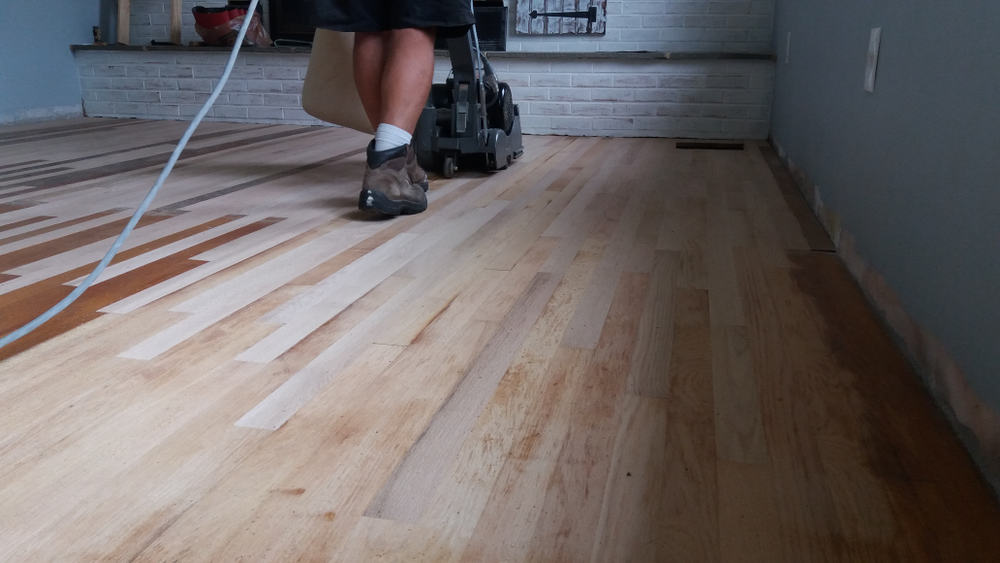
They count on that gap. They come in at $1,800 — close enough to what you read online to feel right — and win the job on price alone. What they don’t tell you is that the stair work isn’t included. Or that furniture moving is extra. Or that the repair work they discover once they’ve started will be billed as a change order. By the time you realize what’s happening, they’ve already got your deposit and they’re halfway through your floors.
Labor accounts for up to 80% of a floor sanding project’s total cost. That’s not a minor variable — it’s the whole ballgame. A contractor who bids 40% below every other quote isn’t working more efficiently. They’re cutting corners on the labor itself: fewer sanding passes, lower-grade finish products, less time on edge work, rushed cure times between coats.
Nassau County’s housing stock also plays a role here. The median home in this county was built in 1955. A significant portion of homes were built before 1940. Those original hardwood floors — the red and white oak that’s under carpet in tens of thousands of Levittown Capes, Garden City Colonials, and Massapequa ranches — are 60 to 80 years old. They’ve seen decades of wear, and in many cases they’ve never been professionally refinished. That means more prep work, more careful sanding, and more time.
A contractor who quotes a flat rate without ever seeing your floors isn’t accounting for any of that. A legitimate in-person assessment is the only way to produce an accurate quote. If someone is pricing your job over the phone or by email without ever measuring your square footage or looking at your floor condition, that number isn’t a real quote — it’s a number designed to get you to call back.
What a Legitimate Floor Sanding Quote Should Actually Include
A fair, honest quote isn’t just a number. It’s a document. If a contractor hands you a single-line estimate — “floor refinishing, 900 sq ft, $1,800” — you don’t have enough information to evaluate it, let alone protect yourself if something goes wrong.
A legitimate written quote should specify the square footage being worked, broken down by room if the scope is complex. It should name the finish product being used — not just “polyurethane,” but the actual brand and formulation. It should state whether dustless sanding equipment is being used, because that affects both the process and the price.
Stair refinishing, if applicable, should appear as its own line item — stair work costs $40 to $75 per stair due to the complexity involved, and it’s one of the most common things lowball contractors quietly omit from their initial number. Furniture moving should be addressed explicitly: is it included, or is it your responsibility?
The quote should also include a payment schedule. A legitimate contractor will typically ask for a deposit of 10 to 30 percent of the project cost. If someone asks for 50 percent or more upfront before a single board has been touched, that’s a meaningful red flag. And the quote should reference a warranty on labor — a contractor who stands behind their work will put that in writing.
One more thing worth asking before you sign: who will actually be on your floors? The estimator who came to your home and the crew doing the work are sometimes two very different parties. In a market like Nassau County, where you’re trusting someone with floors in an $800,000 home, knowing whether the owner is involved in the project — not just the sale — matters. It’s a question most homeowners never think to ask, and most contractors never volunteer an answer.
How Hardwood Floor Refinishing Contractors Separate Themselves From the Pack
Price is the easiest thing to compare. It’s also the least reliable signal of quality. The things that actually separate a skilled floor refinishing contractor from a mediocre one are almost invisible in a quote — they show up in the work itself, weeks or months after the check clears.
What you’re really evaluating when you vet a contractor is their process, their accountability, and their track record. A contractor who’s been working Nassau County floors for decades has seen conditions that out-of-area or inexperienced operators haven’t — the way coastal humidity affects finish curing in summer, the quirks of 70-year-old subfloors, the difference between red oak and white oak and how each responds to stain. That kind of local knowledge doesn’t show up in a quote. But it shows up in the result.
What to Ask Hardwood Floor Sanding Contractors Before You Hire
Most homeowners ask two questions: how much and how long. Those are reasonable starting points, but they’re not enough. Here are the questions that actually tell you something.
Ask whether they’ll show you stain samples on your actual floor before they seal it. Not on a chip, not on a board they brought from the truck — on your floor, in your home’s light. The color you choose in a showroom under fluorescent lights is not the color you’ll live with. A contractor who applies samples directly to your floor before committing to a stain is a contractor who’s done this enough times to know that’s how you avoid regret.
Ask what equipment they use for dust management. Even with commercial vacuum systems, there’s no such thing as a completely dust-free sanding process — but there’s a significant difference between a contractor who uses professional-grade equipment to capture the majority of dust and one who doesn’t. For Nassau County homeowners with allergies, young kids, or pets, this isn’t a minor detail.
Ask whether they’re licensed with the Nassau County Office of Consumer Affairs. Home improvement contractors working in Nassau County are required to hold a current license with that office. You can verify a contractor’s license status directly — and you should. A license isn’t proof of quality, but the absence of one is a clear signal to walk away.
Ask about their warranty. A contractor who’s confident in their work will back it in writing. One-year labor warranties are standard among reputable contractors; some offer longer. If the answer is vague or verbal, that tells you something.
Finally, ask for references from Nassau County homeowners specifically — not just general reviews. A contractor who’s done good work in Merrick, Rockville Centre, or Bethpage can usually point you to someone who’ll pick up the phone and tell you about it.
Hardwood Floor Repair Contractors: When Sanding Isn’t the Whole Story
Floor sanding is rarely the complete picture — especially in a county where the average home is 73 years old. Before sanding begins, a skilled contractor assesses the floor for damage that needs to be addressed first: boards that are cracked, cupped, or beyond what sanding alone can correct; gaps that have widened over decades of seasonal expansion and contraction; sections where the subfloor has shifted.
This is another place where lowball bids fall apart. A contractor who quotes your job without thoroughly inspecting the floor condition is either inexperienced or counting on discovering problems mid-project and billing them separately. Board replacement and repair work costs $6 to $12 per square foot — and if that’s not addressed in your initial quote, it can show up as a significant change order once the crew is already in your home and you have limited leverage.
A legitimate hardwood floor repair contractor treats the assessment as part of the job, not an afterthought. They walk the floor before they quote it. They identify which boards need attention, whether any areas have subfloor issues, and whether the floor as a whole can be refinished or whether certain sections need to be replaced first. That information goes into the quote — not into a conversation you have after work has started.
It’s also worth understanding the limits of what sanding can fix. Solid hardwood floors can typically be sanded and refinished five to eight times over their lifetime. But if your floor is engineered hardwood with a thin top veneer, the number of times it can be sanded is limited by the veneer thickness — and sanding through it means replacement, not refinishing. A contractor who doesn’t check veneer thickness before quoting an engineered floor either doesn’t know to or doesn’t care to. Neither is a good sign.
The repair and assessment phase is where experience shows most clearly. There’s no shortcut for having seen hundreds of Nassau County floors in different conditions — knowing what’s salvageable, what needs work, and what needs to be replaced before the sanding even begins. That knowledge is part of what you’re paying for when you hire a contractor who’s been doing this for decades.
How to Choose the Right Floor Sanding Contractor in Nassau County
The lowest quote is rarely the best deal. In a market like Nassau County — where homes are worth protecting and original hardwood floors are worth doing right — the contractor who earns your trust with a transparent, itemized quote, shows up on time, and stands behind their work is worth more than the one who saves you a few hundred dollars upfront and disappears when something goes wrong.
Do your homework. Verify the license. Ask for the quote in writing. Request references from local homeowners. And pay attention to whether the person who sold you the job actually shows up when the work begins.
If you’re in Nassau County and want a straight answer on what your floors actually need — and what it will realistically cost — we at KO Floors, Inc. offer free, no-obligation in-home quotes. No pressure, no mystery pricing, just an honest assessment from a team that’s been working Long Island floors for over 50 years.